

¶ Parliamentary Proceedings
¶ Result of the vote on 27 September 2026
The Neutrality Initiative was rejected on 27 September 2026 by 70.15% No to 29.85% Yes. All 26 cantons rejected it; the cantonal vote was 0 to 23.
Provisional official final result · Data as of 27 September 2026, 16:12 (Europe/Zurich).
| Result | Votes | Share |
|---|---|---|
| Yes | 789’130 | 29.85% |
| No | 1’854’767 | 70.15% |
Turnout: 47.06%.
The proposed Article 54a will therefore not be added to the Federal Constitution. The background and arguments below document the debate before the vote.
Summary: Both chambers recommend rejection of the Neutrality Initiative. The Council of States' counter-proposal failed due to disagreement with the National Council. The initiative will go before the people without a counter-proposal. The SVP was the only major party that supported the initiative.
¶ 1. Overview
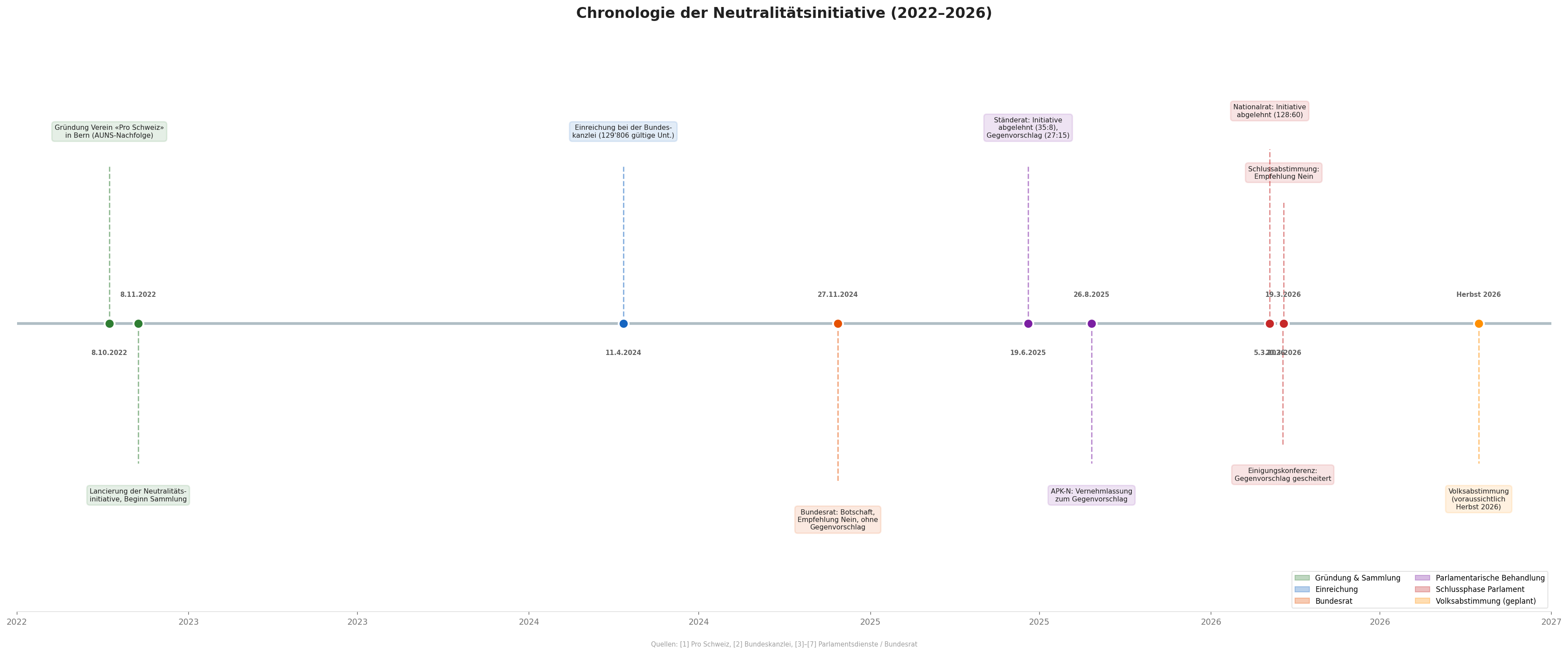
The parliamentary debate spanned two sessions (Summer 2025, Spring 2026). The key outcomes:
- Both chambers recommend rejection of the initiative
- The Council of States' counter-proposal failed in the conciliation conference
- The initiative will go to a popular vote without a counter-proposal
¶ 2. Council of States -- First Reading (19 June 2025)
- Initiative: Rejected by 35 to 8 votes [1]
- Counter-proposal: Adopted by 27 to 15 votes (1 abstention)
- Content of the counter-proposal: Enshrine neutrality as "permanent and armed" in the FC, but without a sanctions ban and without restrictions on military cooperation [1]
¶ 3. National Council -- First Reading (5 March 2026)
Debate duration: approximately 8 hours, 86 speakers from all parliamentary groups [2].
- Initiative: Rejected by 128 to 60 votes [3]
- Only the SVP recommended acceptance
- Counter-proposal: Rejected by 109 to 77 votes (2 abstentions) [3]
- Yes votes: SVP as well as parts of The Centre and GLP
¶ 4. Reconciliation Process (March 2026)
The chambers agreed on the initiative (both No) but disagreed on the counter-proposal:
| Round | Date | Council of States | National Council |
|---|---|---|---|
| 2nd round | 11 March 2026 | Insists: 21:21 + President's casting vote | Rejects again |
| 3rd round | 17/18 March | Insists: 23:21 | Rejects: 107:80 |
¶ 5. Conciliation Conference (19 March 2026)
The conciliation conference proposed non-entry on the counter-proposal [4]:
- Council of States: 29 Yes, 11 No, 4 abstentions
- National Council: 126 Yes, 64 No, 2 abstentions
¶ 6. Final Vote (20 March 2026)
Both chambers recommend that the people reject the initiative. The initiative will go to a popular vote without a direct counter-proposal.
¶ 7. Party Positions
| Party | Initiative | Counter-proposal | Core argument |
|---|---|---|---|
| SVP | Yes | Yes (tactical) | Success model, identity, sovereignty |
| SP | No | No | Sanctions ban undermines human rights policy |
| FDP | No | No | Economic risks, 175 years of flexible neutrality |
| The Centre | No | Yes (partially) | Compromise attempt via counter-proposal |
| Greens | No | No | Isolation instead of cooperation |
| GLP | No | Yes (partially) | Foreign policy flexibility needed |
¶ References
[1] swissinfo.ch (2025). Council of States recommends rejection of Neutrality Initiative.
SWI swissinfo.ch. [Open Access]
[2] NZZ (2026). Parliament debates Switzerland's self-image.
Neue Zuercher Zeitung. [Open Access]
[3] swissinfo.ch (2026). National Council rejects constitutional article on neutrality.
SWI swissinfo.ch. [Open Access]
[4] swissinfo.ch (2026). Counter-proposal to Neutrality Initiative is off the table.
SWI swissinfo.ch. [Open Access]
Political update: 6 September 2026; background reference: March 2026