

¶ Demand 3: Citizens' Dividend from an AI Citizens' Fund
The question is not whether we can afford a basic income. The question is whether we can afford not to have one.
¶ Core Demand
Within two years, a new popular initiative for a citizens' dividend must be launched. Funding comes from an AI value creation levy. The transition occurs in three phases and replaces OASI in the long term.
¶ Why OASI Will Not Survive
OASI is based on wage contributions. When AI takes over the work of accountants, analysts and lawyers, the contributions disappear -- while the benefit entitlements remain. OASI was created in 1948 for a world in which people were employed for forty years and then drew a pension for fifteen [1].
Two developments are undermining this model:
- Demographics: The Swiss fertility rate stands at 1.39 (2023). The baby boomers are retiring. The share of 20- to 64-year-olds is falling from 65 to 55 per cent by 2050 [2].
- Automation: McKinsey estimates that 46 per cent of all working hours in Switzerland could already be automated today [3]. KOF ETH has documented measurable effects: job postings for programmers fell by 20 per cent in the first eight months after ChatGPT [4].
OASI currently pays out around 50 billion francs per year. The fiscal gap from AI displacement could grow to 75 to 116 billion by 2050 [5].
¶ The Model: Citizens' Dividend, Not Social Transfer
¶ The Liberal Origin of the Idea
The idea is not left-wing. Milton Friedman -- Nobel laureate, father of monetarism, advisor to Ronald Reagan -- proposed the negative income tax in 1962: anyone below a threshold income receives a payment, without means testing [6]. Friedrich Hayek endorsed a basic income for the same reason: it creates freedom from the state, not dependence [7].
¶ Functioning Models
- Alaska Permanent Fund (since 1982): Oil revenues flow into a sovereign fund (over USD 80 billion). Every resident receives an annual dividend -- in 2022 it was USD 3,284 per person. Established by a Republican governor [8].
- Norwegian Sovereign Wealth Fund (Government Pension Fund Global): Over USD 1.7 trillion, funded by oil and gas revenues. Returns finance public services [9].
¶ The Swiss Model: Cooperative
Switzerland has a unique cooperative tradition: Migros, Coop, Raiffeisen, Mobiliar. An AI citizens' fund based on the cooperative principle would be the logical continuation:
- The AI value creation levy flows into a national fund
- Every citizen is a stakeholder
- The fund's return determines the dividend amount -- not politics
- Fund management is independent (modelled on the SNB)
- Payments through the cantons -- federalism as a safeguard
¶ Three Phases of Transition
| Phase | Period | Citizens' Dividend | OASI Status |
|---|---|---|---|
| 1 | 2028--2035 | approx. CHF 500/month as supplement | OASI remains |
| 2 | 2035--2045 | rises to CHF 2,500/month | OASI integrated into dividend |
| 3 | from 2045 | universal dividend | OASI, DI, social assistance replaced |
The BVG pension (occupational pension) continues as capital-funded supplementary income -- it is financed from assets, not from wage contributions.
¶ Replacement of OASI by the Citizens' Dividend
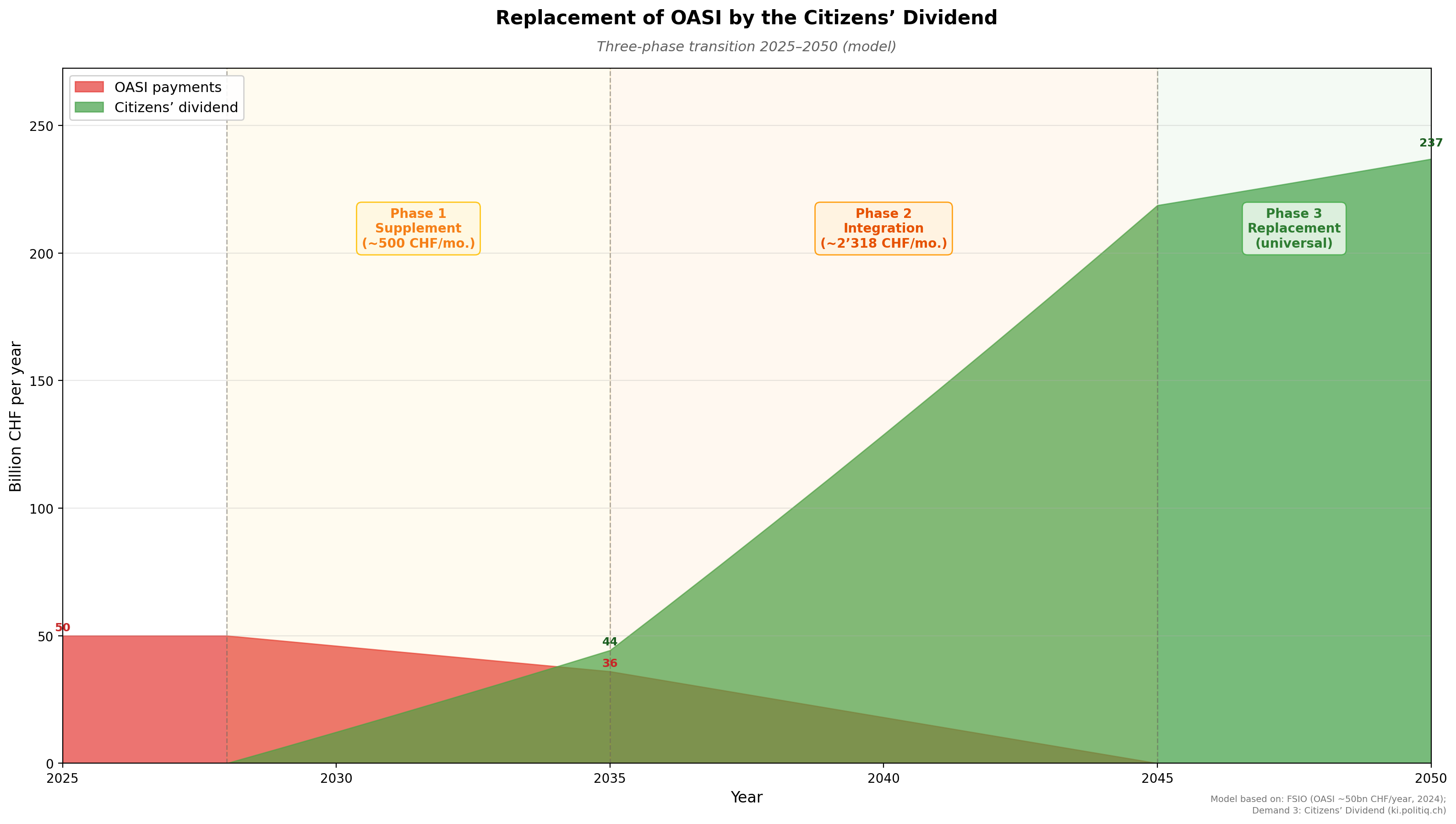
Description: Three-phase transition from OASI to citizens' dividend. Phase 1 (2028–2035): ~500 CHF/month supplement. Phase 2 (2035–2045): rises to ~2'318 CHF/month. Phase 3 (from 2045): universal dividend replaces OASI. Population growth: 6.9→8.1 million adults.
¶ Average Income Development with Citizens' Dividend
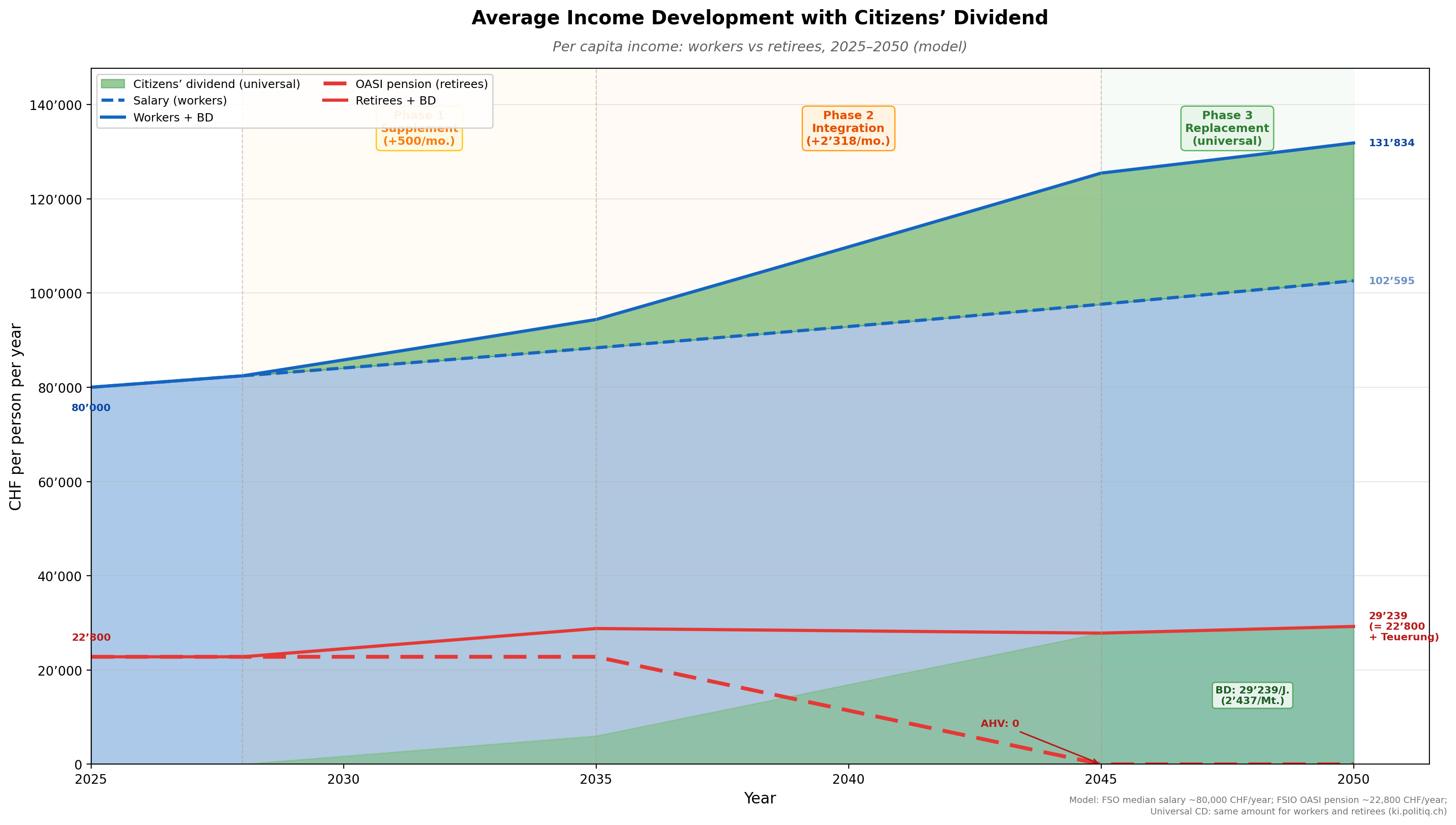
¶ Description: Workers (blue): median salary ~80'000 CHF/year + universal dividend (~29'200 CHF/year by 2050). Retirees (red): OASI declines to zero, exactly replaced by the same dividend. No net increase: 2050 = 22'800 + inflation.
¶ The Calculation
| Item | Amount |
|---|---|
| Gross UBI (CHF 2,500/month x 9 million adults + CHF 1,500 x 1.5 million minors) | CHF 297 billion |
| Deduction: eliminated social transfers (OASI, DI, supplementary benefits, social assistance) | -CHF 80 billion |
| Deduction: income tax on UBI, consumption reflux | variable |
| Net funding requirement | CHF 150--180 billion |
| Current wage-related levies (which will disappear by 2050) | CHF 220 billion |
The AI value creation levy, a financial transaction tax and the reallocation of existing social budgets could cover the net requirement.
¶ Empirical Evidence
| Study | Result |
|---|---|
| Finland (2017--2018, KELA) | Recipients were happier, healthier and just as likely to be employed [10]. |
| Stockton, USA (SEED, 2019--2021) | Full-time employment rose from 28 to 40 per cent [11]. |
| Kenya (GiveDirectly, since 2016) | Long-term positive effects on entrepreneurship and health [12]. |
¶ The UBI Referendum of 2016 -- and What Has Changed
On 5 June 2016, Switzerland became the first country to vote on a UBI: 76.9 per cent said No [13]. Ten years later, the situation has fundamentally changed. ChatGPT did not exist. KOF ETH had not documented any measurable labour market effects. The singularity was science fiction. The world of 2016 no longer exists.
¶ Sources
[2] FSO, Population Scenarios 2023--2055, Reference Scenario A-00-2025.
[3] McKinsey Global Institute: A Future That Works: Automation, Employment, and Productivity. 2017.
[4] KOF ETH Zurich, Labour market effects of generative AI, 2023.
[5] FSO; SNB; SECO; McKinsey; own model calculation.
[6] Friedman, Milton: Capitalism and Freedom. University of Chicago Press, 1962.
[8] Alaska Permanent Fund Corporation.
[9] Norges Bank Investment Management, Government Pension Fund Global.
[10] KELA (Finnish Social Insurance Institution): Final Report UBI Experiment, 2020.
[11] Stockton Economic Empowerment Demonstration (SEED): Final Report, 2021.
[12] GiveDirectly, Long-term study on basic income in Kenya.