

¶ Scenario 1: Work -- The End of Routine
Forecast: By 2040, more than 40 per cent of all routine tasks in Switzerland will be performed by AI or robots -- around 32 per cent of all employed persons are affected.
¶ Three Waves of Automation
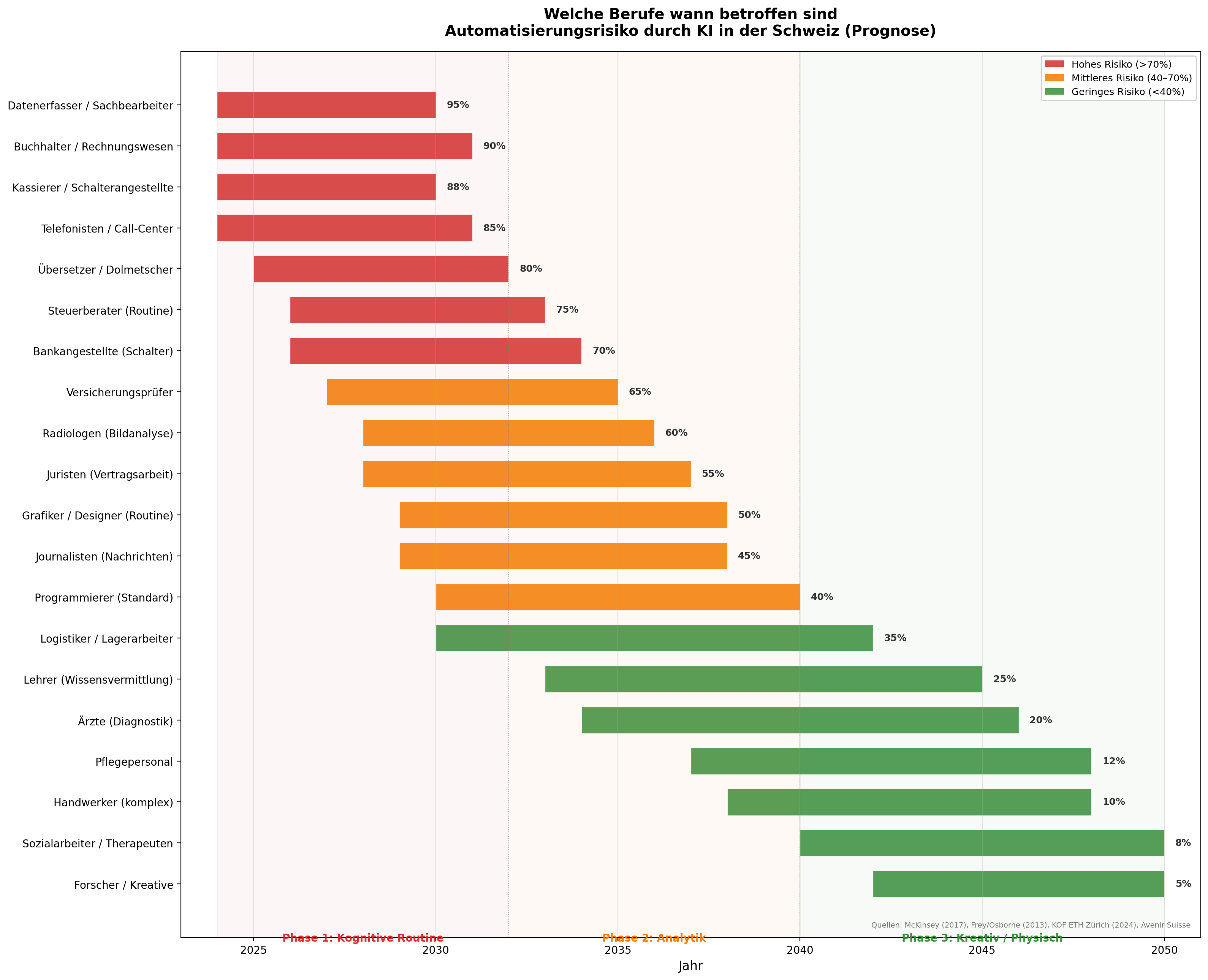
Automation does not hit all occupations at the same time. The sequence is counter-intuitive: it is not physical work that falls first, but cognitive routine.
¶ Wave 1: Cognitive Routine (2024--2035)
Administrative staff, bookkeepers, cashiers, call-centre workers, translators, tax advisers. Occupations whose core consists of rule-based information processing. The KOF Swiss Economic Institute at ETH Zurich has already measured the effect: in the first eight months after the launch of ChatGPT, job postings for programmers fell by 20 per cent and for image generation by 17 per cent [1]. Avenir Suisse estimates the number of office workers in direct AI competition at 490,000 [2].
Here, no robot is needed -- just software.
¶ Wave 2: Structured Manual Occupations (2033--2040)
Bank employees, insurance assessors, radiologists, routine lawyers, graphic designers, news journalists. Occupations that require judgement -- but a judgement based on pattern recognition. And pattern recognition is precisely what AI does best.
¶ Wave 3: Unstructured Environments (from 2040)
Programmers, logistics managers, partially teachers and doctors. Tradespeople, care workers, social workers and creatives remain protected the longest.
¶ Why Roofers and Plumbers Will Be Last
The irony of history: the occupations that are worst paid and least valued may be the last in which humans outperform machines.
A roofer works on inclined surfaces, in wind and weather. No roof is the same. They must improvise -- a tile does not fit, so they cut it to size. The task requires a combination of spatial thinking, whole-body coordination, haptic fine motor skills and the ability to react to changes in split seconds.
A plumber faces a similar challenge: pipes run through walls, ceilings, floors -- and rarely where the building plans suggest. They work in confined spaces, must feel, smell, listen. Both occupations share what keeps automation at bay the longest: an unpredictable physical environment, the necessity of whole-body action, and problem-solving that is in no manual.
¶ The Swiss Calculation
The FSO counts around 5.5 million employed persons in Switzerland at the end of 2024. The gross median wage is CHF 7,024 per month [3]. For every franc of gross wage, approximately 48 per cent is levied in charges (OASI/DI/IC, UI, occupational pension, taxes) -- yielding around CHF 40,000 per position per year flowing to social insurance and taxes.
Forecast for the fiscal gap:
| Date | Net displaced positions | Annual gap |
|---|---|---|
| 2032 | 636,000 | CHF 24 bn |
| 2040 | 1.64 million | CHF 61 bn |
| 2050 | 2.0 million | CHF 75--116 bn |
McKinsey estimates that 46 per cent of all working hours in Switzerland could already be automated today [4]. The above forecasts are more conservative: 12 per cent by 2032, 32 per cent by 2040, 42 per cent by 2050.
¶ What This Means
The Swiss social insurance system, built on OASI contributions from wage labour, will have to be rethought. A social system based on wage-based contributions cannot finance a world without wage labour -- regardless of the currency.
Economic logic leaves no alternative: an AI system that does the work of ten lawyers for the cost of one will be deployed by every profit-driven company. The history of automation shows not a single case in which an economically superior technology was permanently kept out of the market.
¶ Bibliography
[1] KOF ETH Zurich: AI and the Swiss Labour Market -- Initial Evidence. KOF Analyses, 2023.
[2] Avenir Suisse: Structural Change and Employment in Switzerland. Zurich, 2024.
[3] Federal Statistical Office (FSO): Swiss Earnings Structure Survey 2022. Neuchatel, 2024.
[4] McKinsey Global Institute: A Future That Works: Automation, Employment, and Productivity. January 2017.