

¶ Scenario 5: Peak Human -- The Shrinking Population
Forecast: "Peak Human" -- the moment when the world population reaches its maximum -- will occur between 2060 and 2080, earlier than UN projections suggest.
¶ The Demographic Implosion
As prosperity increases, the birth rate falls. Everywhere. Without exception. This demographic correlation is one of the most robust findings in social science [1].
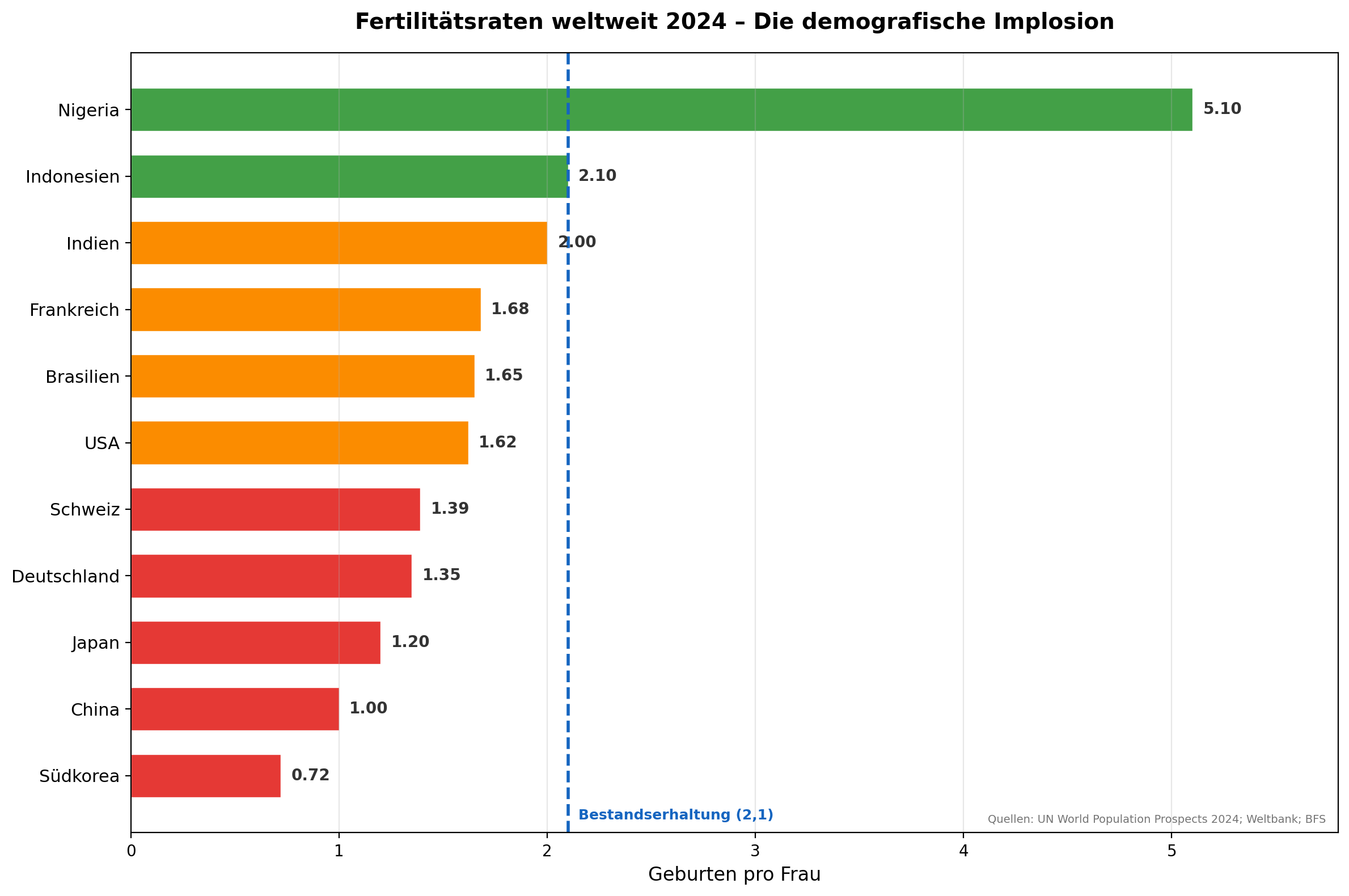
| Country | Fertility rate | Replacement level |
|---|---|---|
| South Korea | 0.72 | -- |
| Seoul (alone) | 0.64 | -- |
| China | ~1.00 | -- |
| Japan | 1.20 | -- |
| Germany | 1.35 | -- |
| Switzerland | 1.39 | -- |
| Required | 2.10 | Replacement level |
| Nigeria | 5.10 | -- |
South Korea holds the lowest value ever recorded in any country at 0.72 children per woman [2]. Not a single industrialised nation reaches the 2.1 threshold needed for replacement. Not one.
¶ China Is Already Shrinking
China, which officially counts 1.4 billion inhabitants, has a fertility rate of approximately 1.0. The Chinese population has been shrinking since 2022, by millions each year [3]. The one-child policy (1979--2015) left a demographic time bomb that no political measure can now defuse.
¶ Peak Child Has Already Been Passed
Hans Rosling coined the term Peak Child: the maximum number of children on Earth has already been reached. The UN estimates that the peak of children under five was passed in 2017 [4]. The world population is still growing because those already born are living longer. But the base is shrinking.
¶ The Swiss Scenarios
The Federal Statistical Office (FSO) published its ninth series of population scenarios in April 2025 [5]:
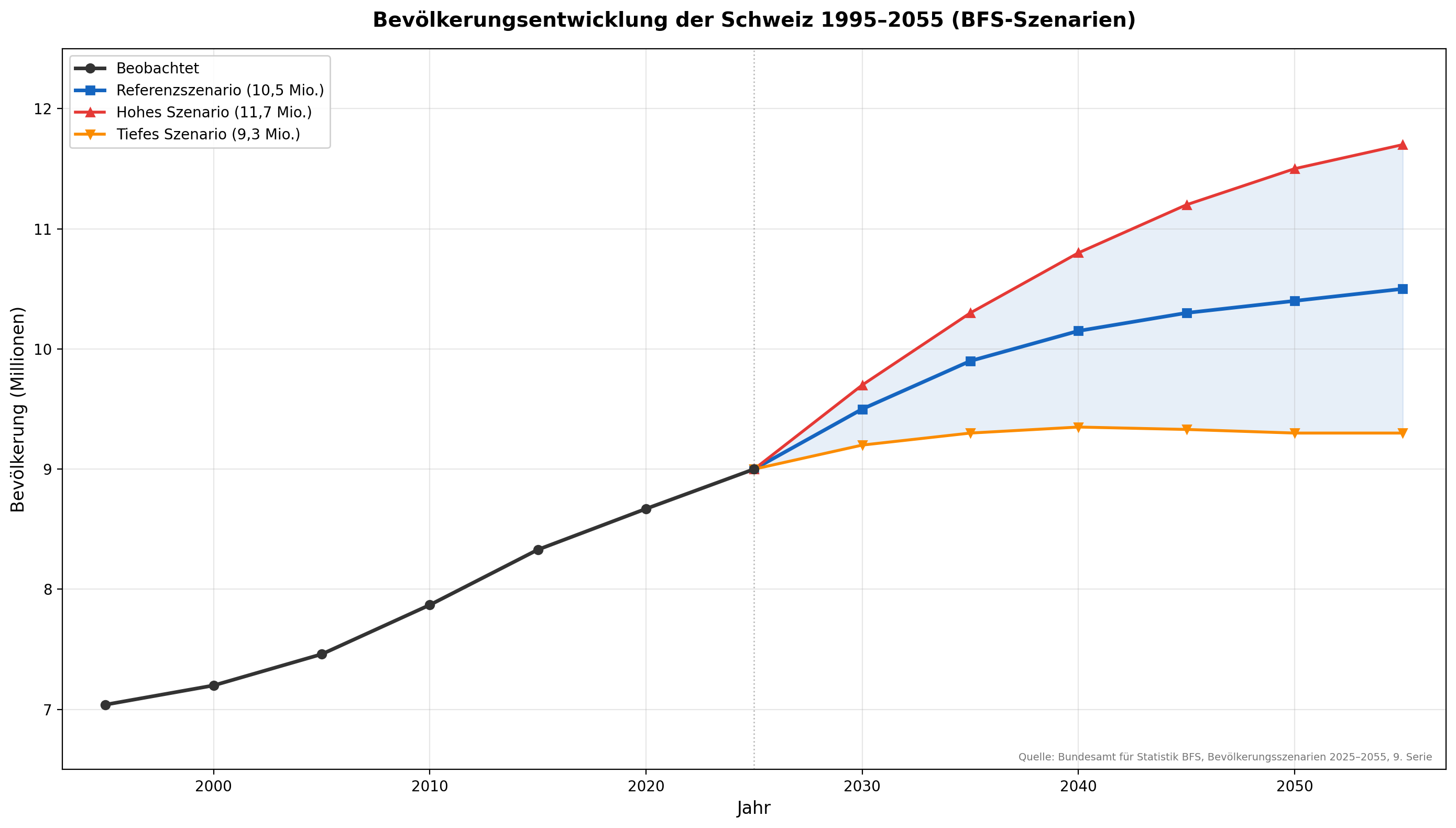
| Scenario | Population 2055 | Trend |
|---|---|---|
| Reference | 10.5 million | Growth through migration |
| High | 11.7 million | Strong immigration |
| Low | 9.3 million | Decline from 2041 |
Growth in the reference scenario is driven almost exclusively by migration. Soon, more people will die in Switzerland each year than are born. In both scenarios, the population is ageing dramatically: the number of over-64s will double, while the working-age population stagnates or shrinks.
¶ The Double Scissors
Two trends reinforce each other:
-
Demographic: The share of working-age people (20--64) falls from 65 to 55 per cent. The baby boomers are retiring. Fewer contributors are funding more pensioners.
-
Technological: AI erodes the remaining contribution base by replacing positions whose wage-based contributions fund the system.
Two scissors opening simultaneously.
¶ What This Means
Forecast: AI will dramatically accelerate the demographic transformation in developing countries. Education, career opportunities for women, urban lifestyles -- all reduce the fertility rate. AI makes these processes accessible without the decades the West needed.
A shrinking humanity produces less -- and needs less. The classical growth paradigm of economics breaks down. Then the world needs fewer workers. And AI stands ready to fill precisely that gap.
Pension systems built on growing generations will have to be redesigned. OASI, funded by wage contributions from a shrinking working-age population, faces its most fundamental challenge since its founding in 1948.
¶ Bibliography
[1] Rosling, Hans: Factfulness: Ten Reasons We're Wrong About the World. Flatiron Books, 2018.
[2] Statistics Korea (KOSTAT): Birth Statistics 2023. Daejeon, 2024.
[3] National Bureau of Statistics of China: Statistical Communique 2022. Beijing, 2023.
[4] United Nations: World Population Prospects 2024. Department of Economic and Social Affairs, New York, 2024.
[5] Federal Statistical Office (FSO): Population Scenarios 2025--2055, 9th Series. Neuchatel, April 2025.