

¶ Scenario 6: Money -- The End of Fiat Currencies
Forecast: By 2050, digital currencies will handle the lion's share of all transactions. The US dollar will lose its role as the global reserve currency. The Swiss franc could survive as one of the last stable state currencies.
¶ Fiat Money Tends Towards Zero
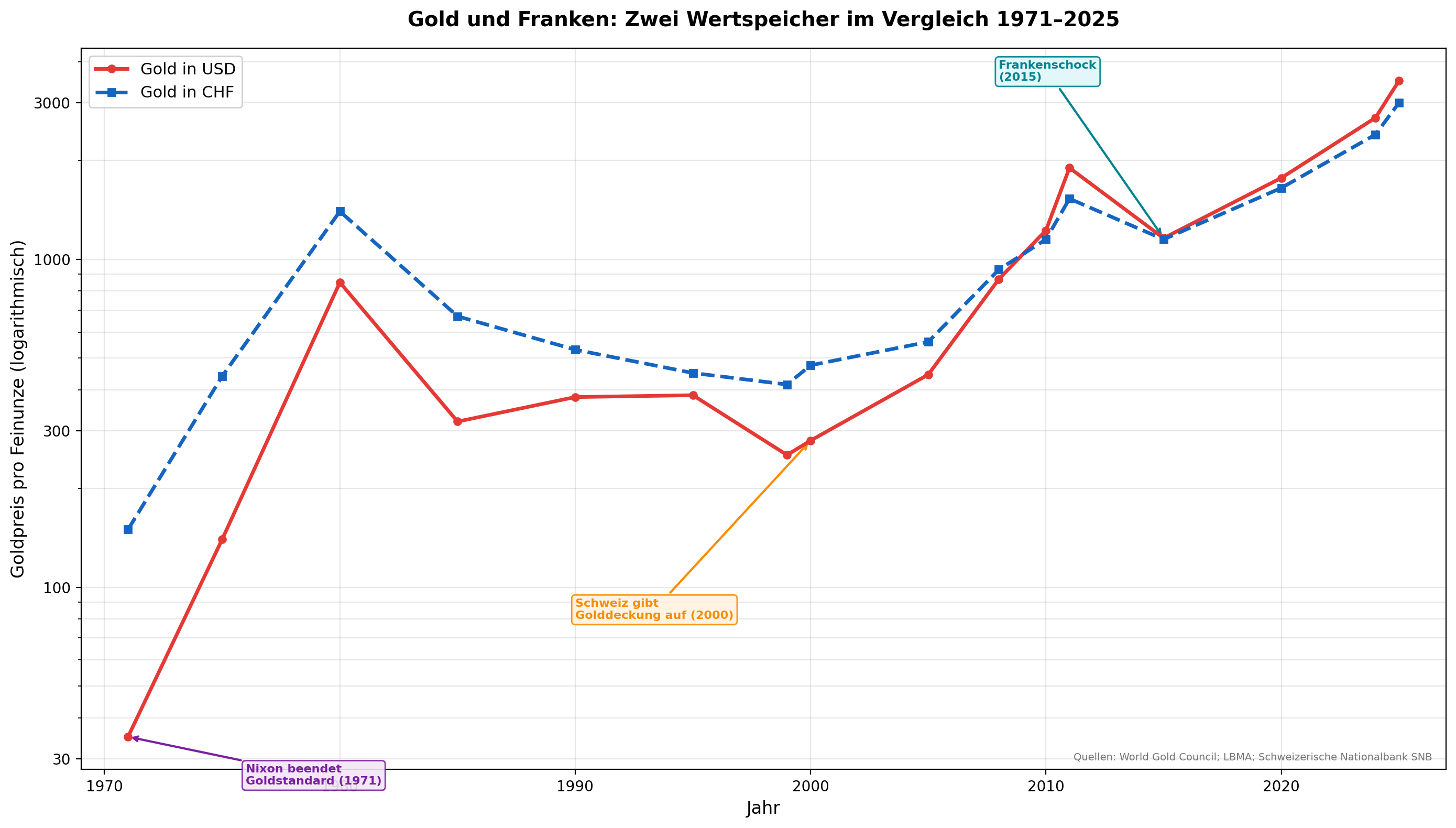
Thomas Mayer, economist and former chief economist of Deutsche Bank, has repeatedly demonstrated: all fiat currencies tend towards zero in the long run [1]. The dollar has lost over 99 per cent of its gold value since the end of the gold standard in 1971. The euro has lost around 30 per cent of its purchasing power since its introduction.
The Swiss franc fares better -- but it is no exception to the principle. It loses value more slowly because the Swiss National Bank (SNB) acts more independently than the ECB and the Federal Reserve.
¶ CBDCs: Digital State Money
Over 130 countries are working on Central Bank Digital Currencies (CBDCs) [2]. China is already testing the digital yuan in everyday life. The ECB is planning the digital euro. The SNB has tested the technical feasibility of a CBDC based on distributed ledger technology with Project Helvetia [3].
Forecast: CBDCs will not abolish cash but will marginalise it. The real question is: will CBDCs be designed as surveillance instruments or as neutral means of payment?
In China, the answer is clear: the digital yuan is programmable -- the state can control what money is spent on and when. In Switzerland, such a design would be unconstitutional. But the temptation to link fiscal control with digital money exists everywhere.
¶ The Dollar Loses Its Status
The US dollar has been the global reserve currency since 1944 (Bretton Woods). This status is eroding:
- BRICS states are increasingly trading in local currencies.
- Saudi Arabia is accepting non-dollar payments for oil for the first time.
- Central banks worldwide are diversifying their reserves away from the dollar, towards gold [4].
Forecast: The dollar will not fall abruptly but will gradually lose significance -- much as the British pound lost its dominance between 1914 and 1956.
¶ Gold as an Enduring Store of Value
Gold has preserved its function as a store of value for over 5,000 years. In a world where digital currencies come and go, physical gold remains the ultimate anchor. Gold cannot be manipulated by algorithms, is not endangered by server outages, and cannot be devalued by political decisions [5].
¶ The Franc as a Stability Anchor
Forecast: The Swiss franc could ironically survive as one of the last stable state currencies -- precisely because Switzerland operates a smaller, more controlled and democratically accountable monetary policy.
The Swiss financial sector, already engaged with digital asset custody, could become the trustee of a new global value order. FINMA was among the first supervisory authorities worldwide to establish a clear regulatory framework for crypto assets [6].
¶ The Fiscal Dimension
If Elon Musk is right that "money will be irrelevant", the real question is: what form of value storage remains meaningful in a world without wages?
The fiscal gap of CHF 75 to 116 billion gains an additional dimension: if the currency itself loses value, the nominal gap grows larger. But the real question remains the same -- it is not about francs or dollars. It is about how a society distributes value creation when machines generate it and humans no longer earn it.
¶ Bibliography
[1] Mayer, Thomas: Die neue Ordnung des Geldes. FinanzBuch Verlag, 2014.
[2] Atlantic Council: Central Bank Digital Currency Tracker. 2025.
[4] World Gold Council: Gold Demand Trends Full Year 2024. London, 2025.
[6] FINMA: Guidelines for ICO Enquiries. Bern, 2018 (updated 2024).