

¶ Scenario 8: Space -- Data Centres on the Moon
Forecast: By 2050, the first commercial data centres will be operating outside the Earth's atmosphere -- in Earth orbit and on the Moon.
¶ Why Space?
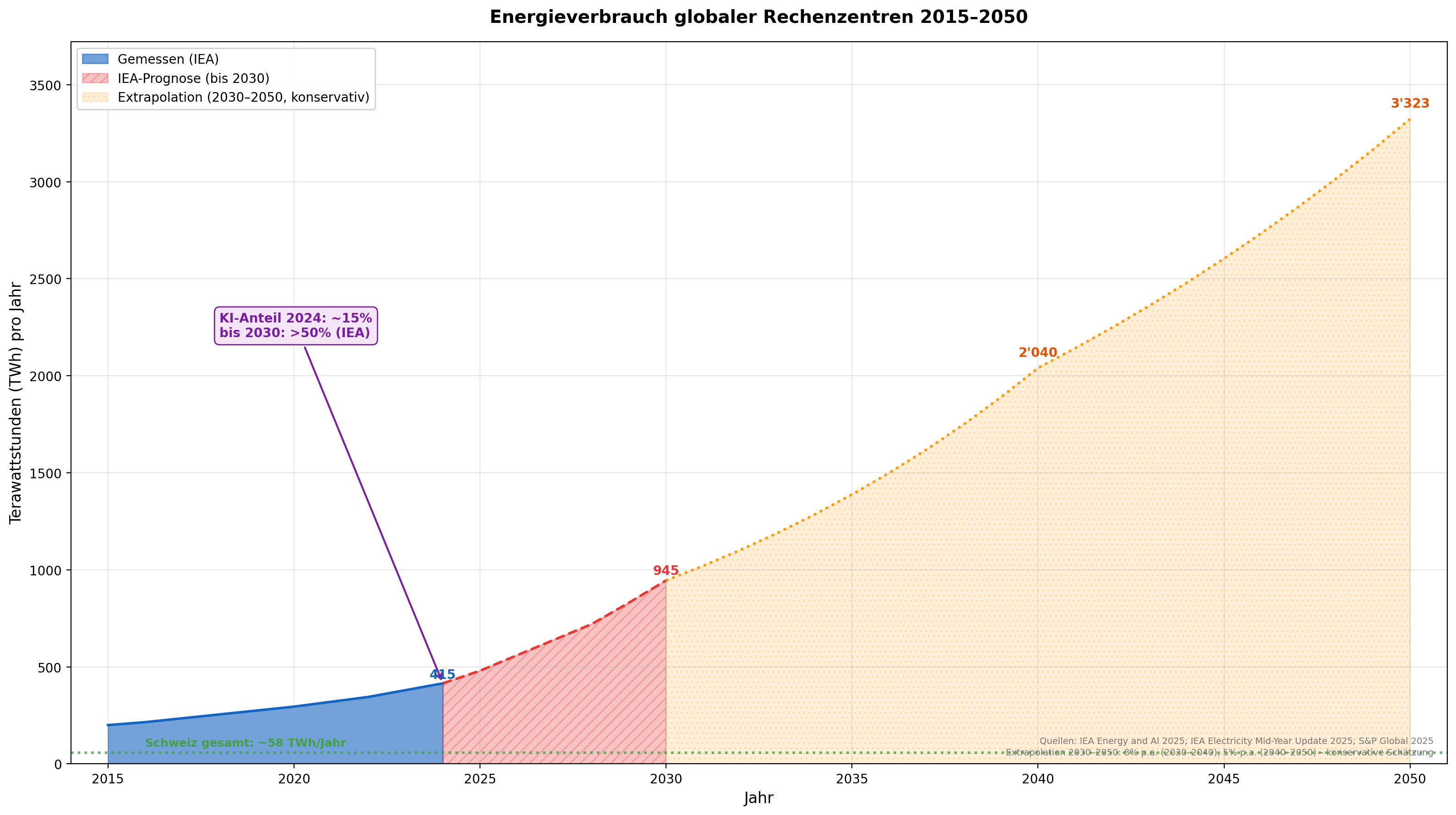
AI needs energy. The Earth does not have enough of it. Data centres already consume 415 terawatt-hours of electricity per year in 2024 -- trend: doubling by 2030 [1]. At some point, the Earth hits limits: not physical ones, but political ones. Approval procedures for power plants take decades. Power grids are overloaded. Residents protest.
Space solves three problems simultaneously.
¶ Problem 1: Energy
A solar cell in space generates around five times more electricity per square metre than the same cell on the Earth's surface [2]. The reason: the Earth's atmosphere absorbs and reflects 55 to 60 per cent of solar radiation -- through clouds, dust, water vapour and gases. In a vacuum, the full radiation intensity of 1,361 watts per square metre hits the cell without attenuation.
| Location | Sunshine hours/year | Efficiency |
|---|---|---|
| Earth's surface (Switzerland) | ~1,500 h | Baseline |
| Geostationary orbit | ~8,700 h (99%) | 5x |
| Lunar south pole (crater rims) | ~8,500 h | ~5x |
In orbit, there is no night. On the crater rims of the lunar poles, there is near-permanent sunlight. No clouds, no rain, no winter.
¶ Problem 2: Cooling
The greatest technical challenge of modern data centres is not computation -- it is waste heat. On Earth, cooling systems consume up to 40 per cent of a data centre's total energy consumption.
In space, temperatures on the side facing away from the sun reach minus 270 degrees Celsius -- near absolute zero. On the Moon's night side, temperatures drop to minus 200 degrees. Heat dissipation via infrared radiation into space, without air conditioning, without water, without energy expenditure [3].
The chips run cooler than in any terrestrial data centre -- which extends their lifespan and increases their performance.
¶ Problem 3: Land
On Earth, data centres compete with housing, agriculture and nature conservation for space. On the Moon, there are 38 million square kilometres of surface area -- and not a single resident to file an objection.
¶ Already a Reality
The technology already exists in embryonic form:
- Lonestar Data Holdings (Texas) brought a first hardware module to the Moon in 2024 -- a prototype barely larger than a book, but proof that digital storage on the Moon works [4].
- NASA successfully tested laser communication between Moon and Earth as part of the LCRD programme (Laser Communications Relay Demonstration) -- with data rates of 1.2 gigabits per second, comparable to terrestrial fibre optic [5].
- Latency is 1.3 seconds -- too much for real-time chat, but sufficient for batch processing, training of large models and long-term archiving.
¶ The Vision for 2050
Scenario: Autonomous data centres on the Moon, built by robots that process lunar rock (regolith) into building material. Solar panels on the sunlit crater rims of the south pole region deliver uninterrupted power. The servers sit in natural lava tubes, protected from cosmic radiation and micrometeorites. Maintenance and expansion are handled by robots, controlled by AI itself. The facility is self-sufficient.
¶ Launch Costs Are Dropping Dramatically
SpaceX has reduced launch costs per kilogramme from USD 54,000 (Space Shuttle) to under USD 1,500 (Starship) [6]. This cost reduction by a factor of 36 makes the vision economically conceivable.
| System | Cost per kg to orbit |
|---|---|
| Space Shuttle | USD 54,000 |
| Falcon 9 | USD 2,700 |
| Starship (target) | <USD 1,500 |
¶ What This Means for Switzerland
Whoever wants to operate the AI of the future will have to invest not only in chips and algorithms -- but in rockets, solar panels and lunar infrastructure. The space industry and the AI industry will merge.
Forecast: Switzerland, with its tradition of precision technology and its neutral legal order, could find a place in this new value chain -- perhaps as a trustee for extraterrestrial data, just as it has been for terrestrial assets for centuries.
¶ Bibliography
[1] International Energy Agency (IEA): Electricity Mid-Year Update 2025. Paris, 2025.
[2] NASA: Space-Based Solar Power. nasa.gov (technology briefing, various years).
[3] Heiken, Grant et al.: Lunar Sourcebook: A User's Guide to the Moon. Cambridge University Press, 1991.
[4] Lonestar Data Holdings: First Lunar Data Storage Demonstration. Press release, 2024.
[5] NASA: Laser Communications Relay Demonstration (LCRD). nasa.gov, 2023.
[6] SpaceX: Starship -- Making Life Multiplanetary. spacex.com, 2024.