

¶ Labour Market -- A Thought Experiment with Swiss Figures
¶ The Starting Position
The following calculations use exclusively publicly available data. They invite you to retrace the arithmetic yourself -- step by step, without scaremongering, without glossing over.
¶ Step 1: How many people work in Switzerland?
The FSO counted approximately 5.5 million employed persons at the end of 2024. The median wage is 7,024 francs gross per month -- around 84,000 francs per year. [1]
¶ Step 2: What does each position pay to the state?
Levies are charged on every franc of gross wage -- nearly half:
- OASI/DI/UI: 10.6% (employer and employee combined)
- Unemployment insurance (UI): 2.2%
- Occupational pension BVG: average 18%
- Income tax (federal, cantonal, municipal): effective around 17%
- Total: approximately 48% of gross wage
At an average wage of 84,000 francs, that amounts to around 40,000 francs per position per year in social insurance and taxes. Multiplied by 5.5 million positions: 220 billion francs per year -- Switzerland's entire wage-dependent state funding. [2]
¶ The Three Waves of Automation
¶ Step 3: Which occupations will AI hit?
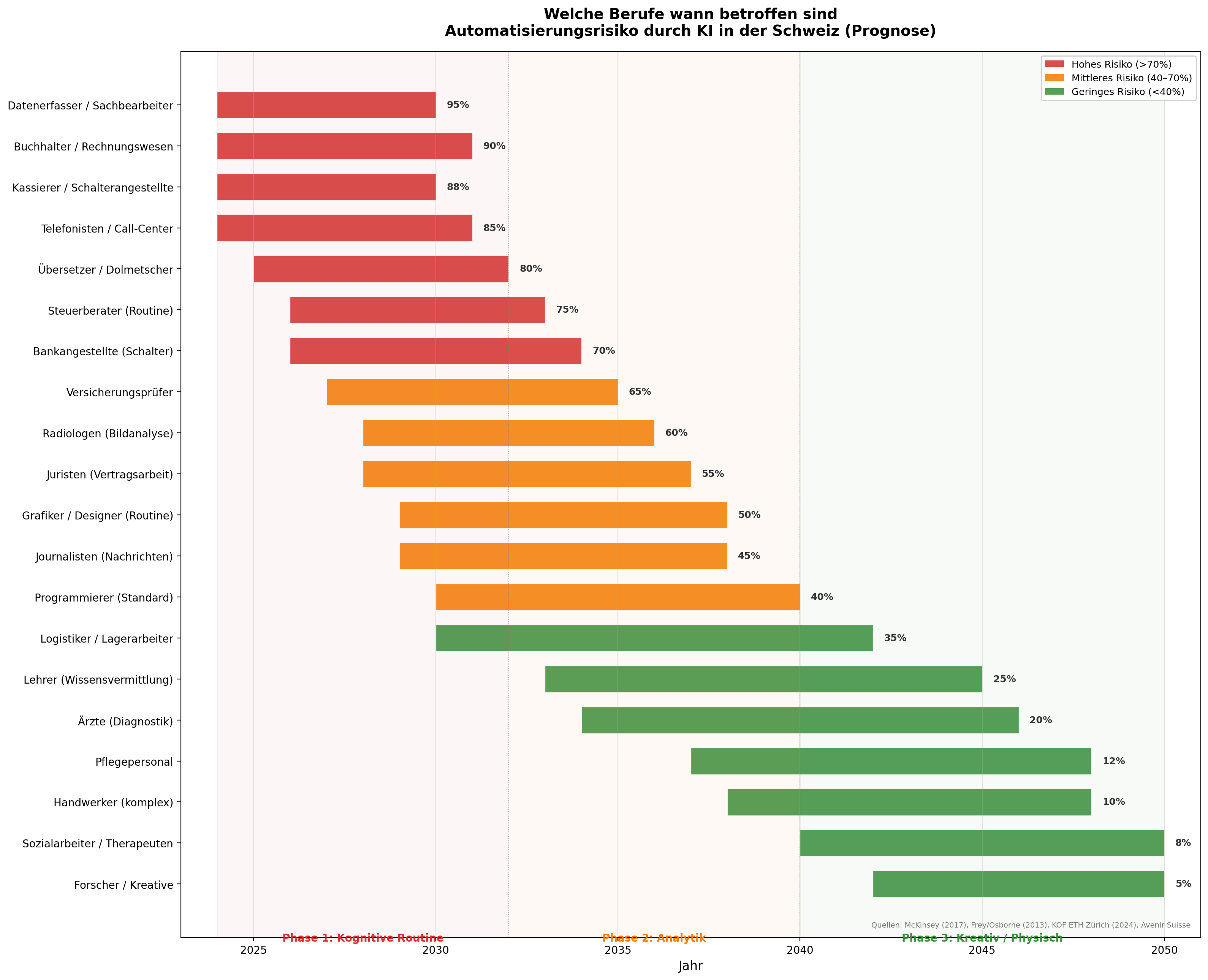
KOF ETH Zurich, McKinsey and Avenir Suisse have analysed the Swiss occupational landscape. The pattern is clear: cognitive routine work is hit first, creative and physically demanding work last. [3] [4]
First wave (to 2032): Clerks, accountants, cashiers, call centre staff, translators, tax advisors. KOF ETH already measured a 20 per cent decline in job postings for programmers and a 17 per cent decline for image generation in the first eight months after the launch of ChatGPT. Avenir Suisse puts the number of office workers in direct competition with AI at 490,000. [5]
Second wave (2033--2040): Bank employees, insurance assessors, radiologists, routine lawyers, graphic designers, news journalists. Occupations that require judgement -- but a judgement based on pattern recognition.
Third wave (from 2040): Programmers, logistics specialists, partially teachers and doctors. Tradespeople, care workers, social workers and creatives remain protected the longest.
¶ Step 4: How many jobs disappear?
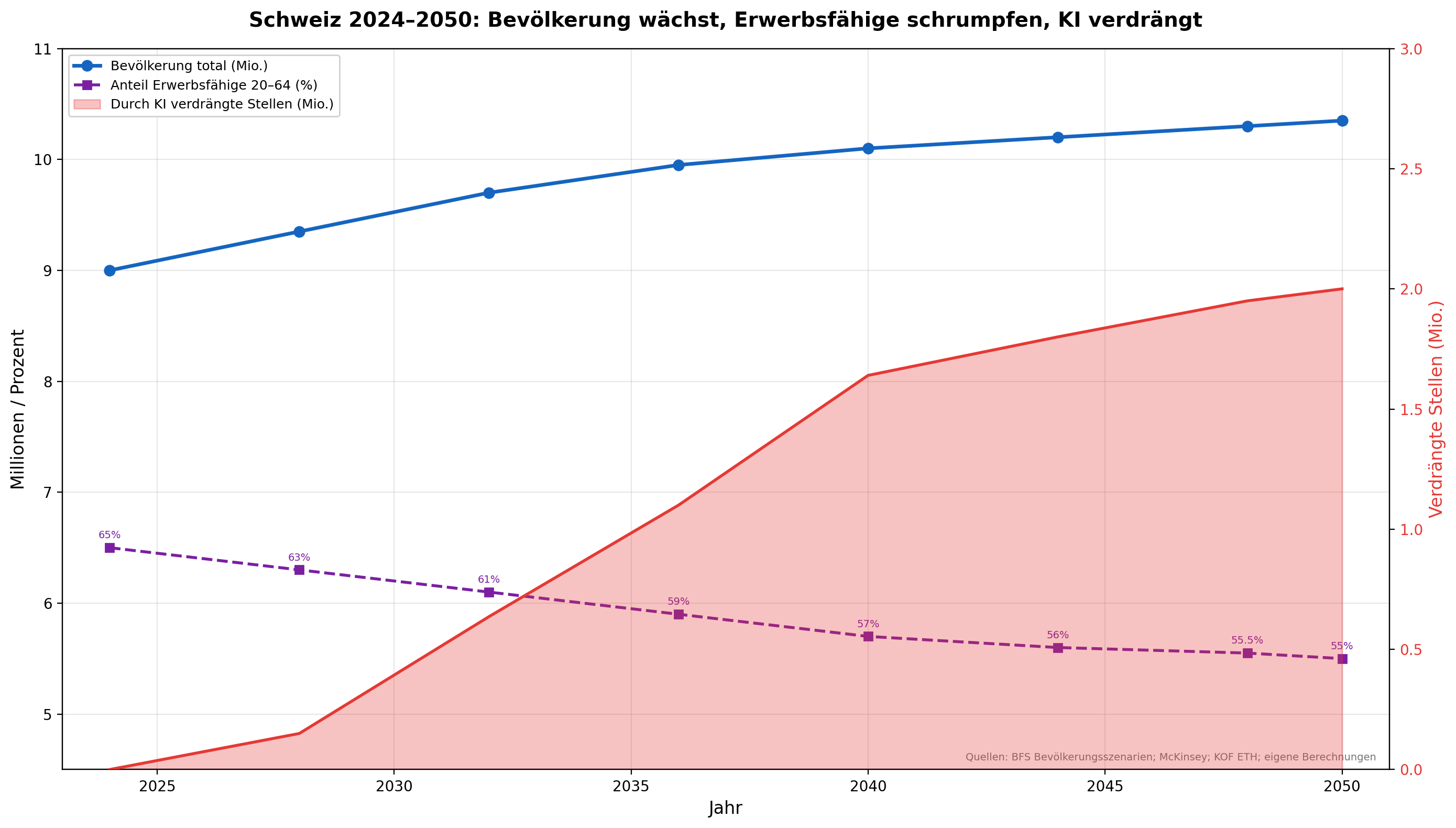
McKinsey estimates that 46 per cent of all working hours in Switzerland could already be automated today. [3] More conservative assumptions:
- By 2032: 12% automated
- By 2040: 32% automated
- By 2050: 42% automated
New jobs in the AI sector compensate for about 10 per cent of the losses. Of the displaced workers, about 40 per cent find equivalent work, 30 per cent find lower-paid positions, and 30 per cent become long-term unemployed.
¶ The Fiscal Gap
¶ Step 5: What does this cost the state?
Every net displaced position costs double: lost revenue (40,000 francs) plus additional social costs for the long-term unemployed (around 45,000 francs per person for UI, social assistance, healthcare costs, retraining).
| Year | Net displaced positions | Lost revenue | Social costs | Annual gap |
|---|---|---|---|---|
| 2032 | 636,000 | CHF 15 bn | CHF 9 bn | CHF 24 bn |
| 2040 | 1,640,000 | CHF 39 bn | CHF 22 bn | CHF 61 bn |
| 2050 | 2,000,000 | CHF 48 bn | CHF 27 bn | CHF 75 bn |
¶ Step 6: The Inflation Effect
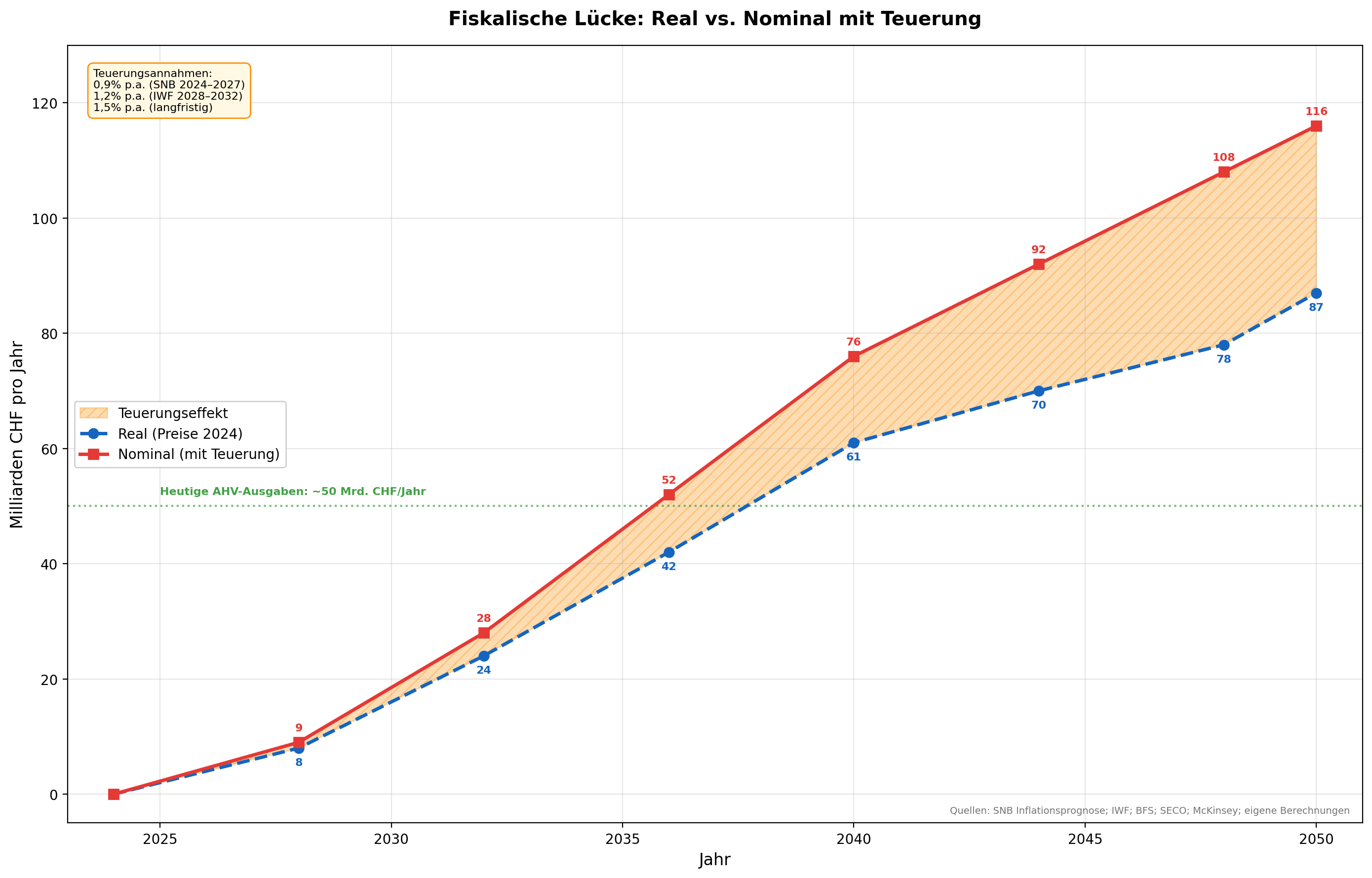
75 billion is the gap in today's francs. But wages rise, and with them the lost levies per position. The SNB projects inflation of 0.2 to 0.6 per cent for 2025--2027. The IMF calculates 0.7 per cent for 2028--2030. Long-term: 1.5 per cent per year. [6] [7]
Cumulatively, this yields a wage adjustment factor of 1.545 by 2050. 75 billion in real gap becomes 116 billion in nominal gap.
¶ Step 7: Is this realistic?
What supports it: The automation rates lie below McKinsey's potential of 46 per cent. Demographic ageing is mathematically certain -- the baby boomers have been born; their retirement is not a scenario but a date. The watch industry lost over 60 per cent of its jobs in 15 years during the quartz crisis.
What argues against it: New occupations will emerge. Regulation and trade unions will delay adoption. Productivity gains generate growth. The Swiss labour market is more flexible than most.
Sober assessment: The projection of 75 to 116 billion francs in annual gap by 2050 is realistic and rather conservative. The greatest uncertainty lies in the speed.
¶ Sources
[1] Federal Statistical Office (FSO): Swiss Wage Structure Survey (LSE) 2022. Median wage CHF 7,024/month.
[2] Federal Social Insurance Office FSIO: Social security statistics, OASI/DI contributions 2024.
[3] McKinsey Global Institute: A Future That Works: Automation, Employment, and Productivity. 2017.
[4] Frey, Carl Benedikt; Osborne, Michael A.: The Future of Employment: How Susceptible Are Jobs to Computerisation? Oxford Martin School, 2013.
[5] KOF ETH Zurich: Effects of generative AI on the Swiss labour market. 2024. Avenir Suisse: Structural Report 2024.
[6] Swiss National Bank SNB: Inflation forecast, December 2025.
[7] International Monetary Fund IMF: World Economic Outlook, Inflation projections 2028--2032.