

¶ Family Budget -- What the AI Transformation Means in Practice
¶ Thomas and Sandra from Ittigen
Figures in billions are abstract. What they mean for individual people becomes visible through a concrete example.
Thomas, 47, is a claims processor at an insurance company in Bern. Sandra, 44, works part-time as an accountant. Two children, a mortgage in Ittigen. A solid Swiss middle-class life, built on work, frugality and reliability.
¶ The Starting Position (2024)
| Item | Amount (CHF/year) |
|---|---|
| Thomas full-time (median wage) | 84,000 |
| Sandra part-time (60%) | 50,400 |
| Gross household income | 134,400 |
| Living costs (rent, food, health insurance, transport, education) | 78,000 |
| Taxes and social contributions | ~40,000 |
| Disposable | ~16,000 |
Not lavish, but manageable. This is how the majority of Swiss families live. [1]
¶ What Happens (2029--2040)
In spring 2029, Thomas is informed that his department is being "restructured". The AI platform handles claims assessment faster, more precisely, for a fraction of the cost. He is 47. In the IT industry, applicants over 45 are considered hard to place. [2]
Three years later, Sandra loses her position too -- accounting is fully automated. Not an isolated case. A pattern. It does not hit the weakest, but the middle -- the solid Swiss middle class.
Claims processors and accountants are among the first wave of AI automation (to 2032) with an automation risk of 85--95 per cent. [3] [4]
¶ AI Deflation: Everything Gets Cheaper
At the same time, however, the cost of living falls. AI-powered agriculture, automated transport, AI tutors instead of expensive private tuition. Technical deflation pushes fixed costs down:
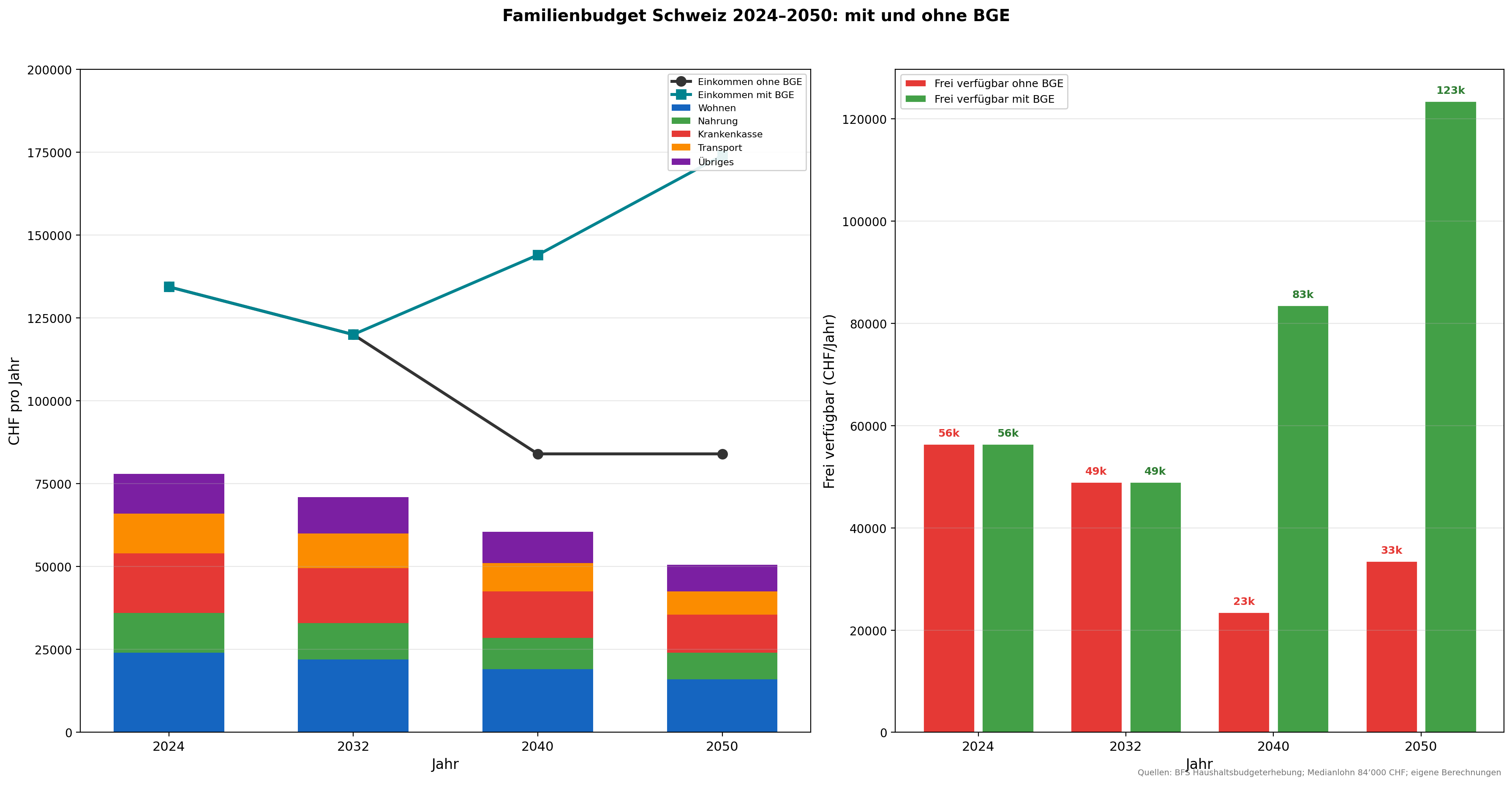
| Item | 2024 | 2035 | 2050 | Change |
|---|---|---|---|---|
| Housing | 24,000 | 20,400 | 16,800 | -30% |
| Food | 12,000 | 9,600 | 7,200 | -40% |
| Health insurance | 14,400 | 12,240 | 10,080 | -30% |
| Transport | 9,600 | 6,720 | 4,800 | -50% |
| Other | 18,000 | 14,400 | 11,700 | -35% |
| Total fixed costs | 78,000 | 63,360 | 50,580 | -35% |
The cervelat gets cheaper, the rent drops, so does health insurance. When robots breed the cattle, AI optimises the logistics and automated factories produce, product prices fall dramatically. [5]
¶ Two Futures from 2040
This is where the path forks. The technology is identical in both scenarios. The difference lies in politics.
¶ Scenario A: Without Basic Income
After his redundancy, Thomas finds a lower-paid position in retail. Sandra works on call. Together they earn 60,000 francs. Despite falling costs, disposable income shrinks to 14,000 francs (2050) -- less than today, even though everything has become cheaper. Why? Because income falls even faster than costs. The family becomes poorer -- not in absolute terms, but in relative terms. Holidays, retirement savings, unforeseen expenses: cancelled.
¶ Scenario B: With Citizens' Dividend (UBI)
An AI value creation levy funds a national citizens' fund. From 2040, every person receives a dividend -- initially 1,250 francs per month, rising to 2,500 francs by 2050. [6]
For Thomas and Sandra, this means: 4 persons x 2,500 x 12 = 120,000 francs in citizens' dividend. Plus any employment income. Minus the still-falling costs. Disposable income rises to over 100,000 francs by 2050.
¶ The Scissors
| Year | Disposable WITHOUT UBI | Disposable WITH UBI |
|---|---|---|
| 2024 | 16,000 | 16,000 |
| 2035 | 12,000 | 38,000 |
| 2040 | 14,000 | 72,000 |
| 2050 | 14,000 | 101,000 |
From 2040, the scissors open. Without UBI, the family becomes poorer even though everything gets cheaper. With UBI, it becomes wealthier than today. The difference lies not in the technology. It lies in politics.
¶ The Lesson
The example of Thomas and Sandra stands for hundreds of thousands of Swiss families. Claims processors, accountants, analysts, insurance assessors -- the middle of society is hit the hardest. Not the unskilled or the highly qualified, but skilled routine workers.
AI deflation alone is not enough. If income falls faster than the cost of living, the middle class becomes poorer -- even in a world where everything gets cheaper. The central political question is: who benefits from the productivity gains of the machines? Only the companies that deploy them? Or society as a whole?
¶ Sources
[3] McKinsey Global Institute: A Future That Works: Automation, Employment, and Productivity. 2017.
[4] Frey, Carl Benedikt; Osborne, Michael A.: The Future of Employment. Oxford Martin School, 2013. Automation risk by occupational group.
[5] Brynjolfsson, Erik; McAfee, Andrew: The Second Machine Age. W. W. Norton, 2014. On technical deflation through automation.
[6] Alaska Permanent Fund Corporation: Annual Report 2022. Dividend per resident: USD 3,284. Model for a cooperative AI citizens' fund.