

¶ Status Quo -- AI on 1 January 2026
As of: January 2026. All figures are based on publicly available sources.
¶ Political decisions: as of 6 September 2026
New political decisions checked on 6 September 2026; earlier background retains its stated reference date.
29.06.2026 — The EU Council gave final approval to amendments to AI rules. Its release specifies delayed high-risk application dates: 2 December 2027 for stand-alone systems and 2 August 2028 for product-integrated systems. This does not postpone every AI obligation; the published legal text remains authoritative. Original source.
04.09.2026 — The Administrative Delegation approved an approximately one-year PIA pilot from the autumn session, costing up to CHF 150,000 from the existing IT budget. Swisscom operates it in Switzerland using open-weight models, without training on inputs. Current internet research is not yet supported. Original source.
06.09.2026 — Verified status: Switzerland is preparing implementation of the Council of Europe AI convention. The Federal Council requested a consultation draft by the end of 2026; an intention to ratify is not completed ratification. Original source.
¶ The Situation in Three Sentences
In January 2026, AI systems are improving faster than humans can follow. Large language models pass bar exams, diagnose diseases and write production-ready code. The threshold to self-optimisation has been crossed.
¶ What Happened in Twelve Months
Between the start of 2025 and January 2026, the AI landscape shifted fundamentally:
- OpenAI runs internal research teams in which AI agents autonomously review code, propose architectures and evaluate benchmarks [1].
- Anthropic demonstrates that Claude independently reads scientific papers, formulates hypotheses and designs experiments [2].
- Google DeepMind reports that Gemini contributed to the development of its own successor version -- measurably, not as a marketing claim [3].
The common denominator: AI writes code that builds better AI. It tests itself, corrects its own errors, optimises its own architecture.
¶ Scaling Laws -- Bigger Means Better
In January 2020, Jared Kaplan and colleagues at OpenAI published a finding that became the central doctrine of the AI industry: the performance of neural language models improves predictably as a power law when three factors are increased -- parameters, training data and compute [4].
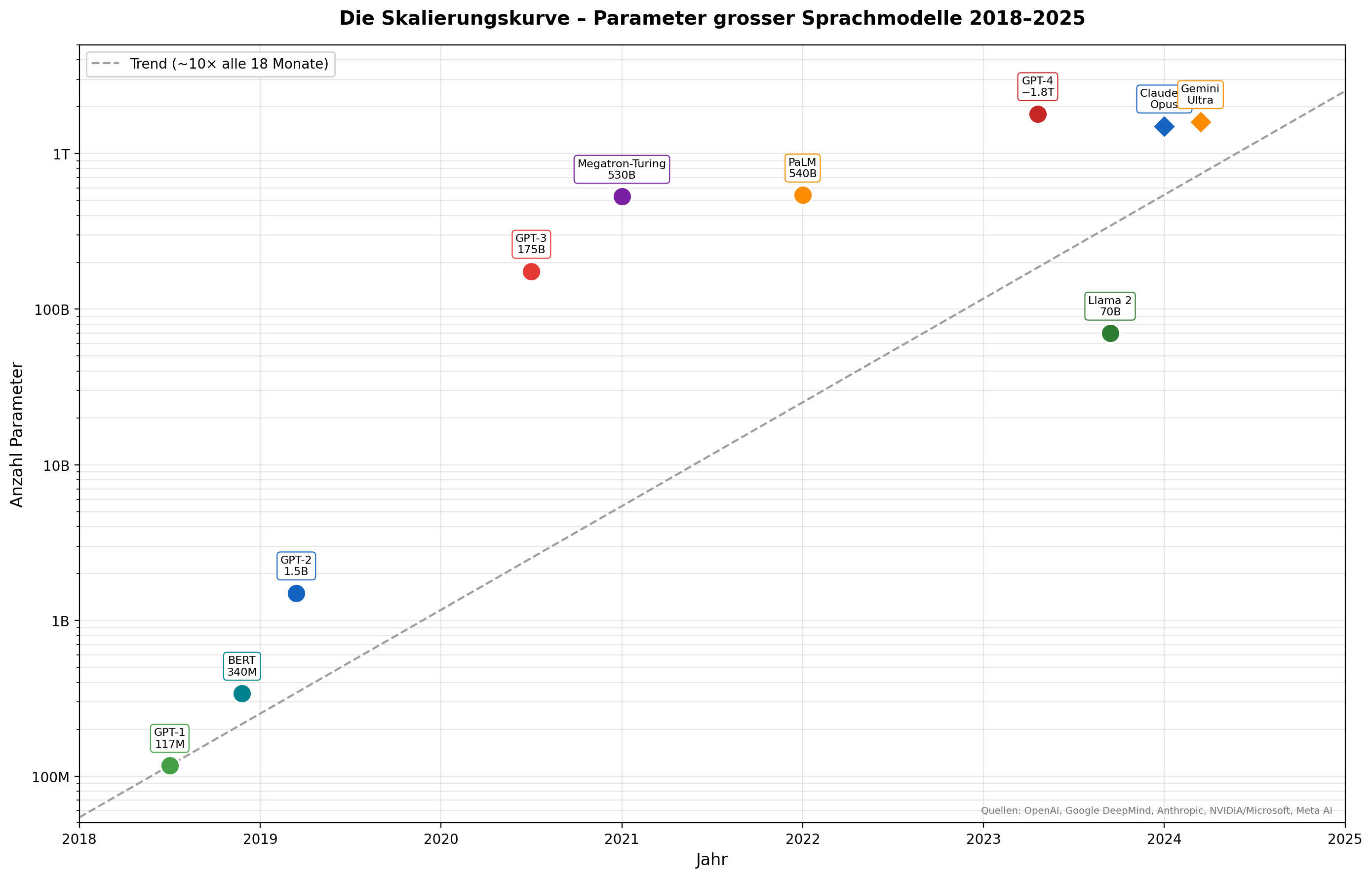
No new algorithms needed. Simply: bigger.
| Model | Year | Parameters |
|---|---|---|
| GPT-1 | 2018 | 117 million |
| GPT-2 | 2019 | 1.5 billion |
| GPT-3 | 2020 | 175 billion |
| GPT-4 | 2023 | ~1.8 trillion (estimated) |
| Claude 3 Opus | 2024 | not disclosed |
| Gemini Ultra | 2024 | not disclosed |
The parameter count roughly increases tenfold every 18 months [1] [3].
¶ The Practical Singularity
The mathematician Vernor Vinge coined the term "technological singularity" in 1993 -- that hypothetical point at which AI systems improve faster than humans can follow [5]. Ray Kurzweil estimated the date as 2045 [6]. He was off by twenty years -- in the wrong direction.
What occurred in early 2026 was not a science-fiction singularity. It was a practical singularity: AI overtook humans where it counts -- at work.
An example: Anthropic's Claude analyses a codebase of one million lines, identifies a subtle bug in the concurrency logic and delivers a correct, tested fix. In minutes. A human expert would need days [2].
¶ What This Means
AI development is no longer linear progress. It is a self-accelerating process. Each new model generation contributes to the development of the next. Humans remain involved -- but their role has shifted: from creator to overseer.
For Switzerland -- with its world-class research at ETH, EPFL and IDSIA -- this is simultaneously an enormous opportunity and an existential challenge.
¶ Bibliography
[1] OpenAI: GPT-4 Technical Report. arxiv.org, March 2023.
[2] Anthropic: Claude 3 Technical Report. anthropic.com, March 2024.
[3] Google DeepMind: Gemini -- A Family of Highly Capable Multimodal Models. December 2023.
[4] Kaplan, Jared et al.: Scaling Laws for Neural Language Models. OpenAI, January 2020.
[5] Vinge, Vernor: The Coming Technological Singularity. VISION-21 Symposium, NASA, 1993.
[6] Kurzweil, Ray: The Singularity Is Near: When Humans Transcend Biology. Viking, 2005.