

¶ AI in the Swiss Economy
As of: January 2026. Figures on the economic transformation driven by AI in Switzerland.
¶ The Baseline in Three Figures
| Key Figure | Value | Source |
|---|---|---|
| Employed persons in Switzerland | 5.5 million | FSO 2024 [1] |
| Gross median wage | CHF 84,000/year | FSO 2024 [1] |
| Wage-dependent state funding | CHF 220 bn/year | Calculation: 48% of 84,000 x 5.5 million |
For every franc of gross wage, approximately 48% is levied in social insurance contributions and taxes: OASI/DI/IC (10.6%), unemployment insurance (2.2%), occupational pension (approx. 18%), income tax (approx. 17%). Multiplied by 5.5 million positions, this yields CHF 220 billion per year, which forms the foundation of Swiss state funding [1] [2].
¶ Who Already Uses AI
The largest Swiss companies are already deploying AI in production -- though as individual initiatives, not as a national system:
| Sector | Company | AI Application |
|---|---|---|
| Pharma | Novartis, Roche | Drug discovery, molecular design, clinical trials |
| Finance | UBS, Credit Suisse (now UBS), Swiss Re | Risk modelling, fraud detection, client advisory |
| Industry | ABB, Buehler | Predictive maintenance, quality control, robotics |
| Insurance | Zurich, Helvetia | Claims processing, underwriting |
| Retail | Migros, Coop | Demand forecasting, logistics optimisation |
¶ The Studies -- What the Numbers Say
¶ McKinsey: 46% Automatable
The McKinsey Global Institute estimated in 2017 that 46% of all working hours in Switzerland are automatable -- not immediately, but technically feasible with existing or foreseeable technology [3]. This affects not only factory work but above all cognitive routine tasks: data entry, bookkeeping, administrative processing, basic legal analysis.
¶ KOF ETH: Programmer Vacancies Down 20%
The KOF Swiss Economic Institute at ETH Zurich has already measured the effect: in the first eight months after the launch of ChatGPT (November 2022), job postings for programmers fell by 20 per cent and for image generation by 17 per cent [4].
This is not a theoretical scenario. It is a measured market reaction -- eight months after the introduction of a single product.
¶ Avenir Suisse: 490,000 Office Jobs
The liberal think tank Avenir Suisse estimates the number of office workers in direct AI competition at 490,000 positions [5]. These are administrative staff, bookkeepers, civil servants, tax advisers -- occupations whose core consists of rule-based information processing.
¶ Frey and Osborne: The Oxford Study
Carl Benedikt Frey and Michael Osborne of the Oxford Martin School published the first major systematic study in 2013: 47% of all US jobs were at risk from computerisation [6]. Their methodology was applied to numerous countries -- including Switzerland.
¶ Three Waves of Automation
The transformation is not uniform. Three waves are emerging:
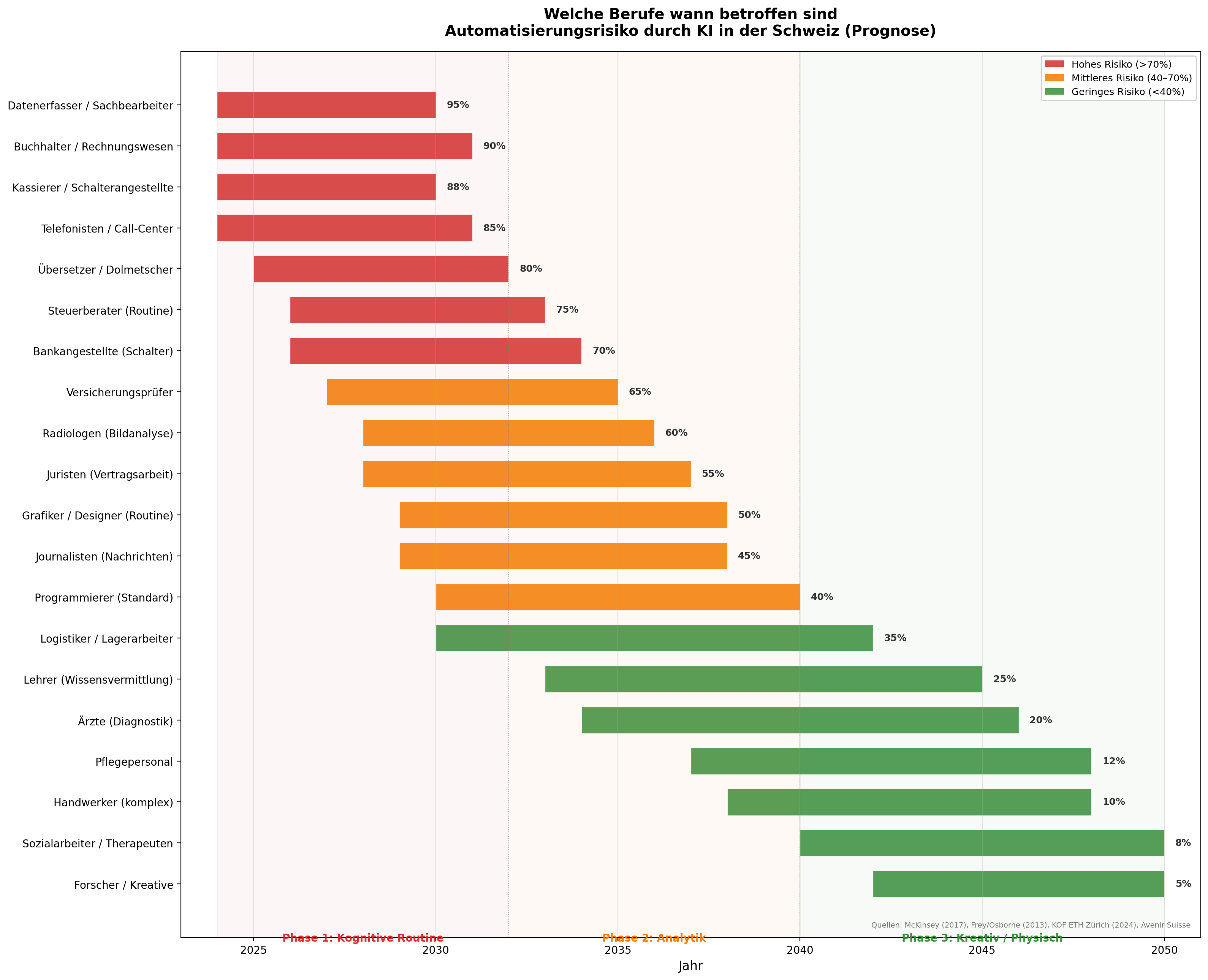
¶ Wave 1: Cognitive Routine (until approx. 2032)
Administrative staff, bookkeepers, cashiers, call-centre workers, translators, tax advisers. Occupations whose core consists of rule-based information processing. Here, no robot is needed, just software [3] [4].
¶ Wave 2: Structured Manual Tasks (approx. 2030--2040)
Warehouse workers, assembly workers, lorry drivers. The environment is controlled -- warehouse, factory, motorway. The tasks are repetitive, the spaces standardised [3].
¶ Wave 3: Creative and Physically Complex Occupations (from approx. 2040)
Programmers (already partially affected), logistics managers, doctors, teachers. Tradespeople, care workers, social workers and creatives remain protected the longest -- because their work requires physical dexterity or genuine human empathy [3] [6].
¶ What This Means for State Funding
The fiscal calculation is simple and brutal:
- 5.5 million employed persons generate CHF 220 billion per year in taxes and social insurance contributions
- If a net 2 million positions are displaced by 2050, CHF 75 to 116 billion per year disappear -- depending on inflation assumptions [1] [2]
- OASI alone already costs CHF 50 billion per year today [2]
Current state funding depends almost entirely on wage labour. When wage labour shrinks, the tax base shrinks -- while benefit entitlements remain.
¶ Counter-arguments
Not every automation potential will be realised. Opposing voices emphasise:
- New occupations will emerge that are not foreseeable today
- Regulation, trade unions and consumer preferences slow adoption
- Productivity gains generate growth and new tax revenue
- The Swiss labour market is more flexible than most European ones
The watch industry lost over 60% of its jobs during the quartz crisis of the 1970s/80s within 15 years -- and recovered. The AI transformation, however, affects a broader base and progresses faster.
¶ Bibliography
[1] Federal Statistical Office (FSO): Employment and Wage Statistics 2024. bfs.admin.ch.
[2] Federal Social Insurance Office (FSIO): OASI Statistics 2024. bsv.admin.ch.
[3] McKinsey Global Institute: A Future That Works: Automation, Employment, and Productivity. 2017.
[4] KOF Swiss Economic Institute, ETH Zurich: Labour Market Effects of ChatGPT. 2023.
[5] Avenir Suisse: Analysis of the Automation of Office Work in Switzerland.
[6] Frey, Carl Benedikt / Osborne, Michael: The Future of Employment. Oxford Martin School, 2013.