

¶ Vision for the Future
Switzerland faces a unique opportunity: the ongoing renewal of its combat aircraft fleet offers the chance not only to secure national defense for decades to come, but also to build a significant industrial hub. This vision shows how this can be achieved.
Detailed analyses and source references can be found in the specialized chapters of this wiki. Several comprehensive studies on the topics described here are available and can be requested from the author.
¶ 1. The Opportunity: A Future-Proof Swiss Air Defense
The security situation in Europe has fundamentally changed. Switzerland can prepare for it -- and more intelligently than a purely conventional rearmament would allow.
The vision rests on four pillars:
| Pillar | Core Idea |
|---|---|
| Mixed Fleet | More combat aircraft, higher availability, diversified risk |
| MRO Excellence | Swiss maintenance competence as a European export factor |
| Technology Ecosystem | Passive sensors and drone detection "Made in Switzerland" |
| Industrial Responsibility | Industry as the driver -- not the state alone |
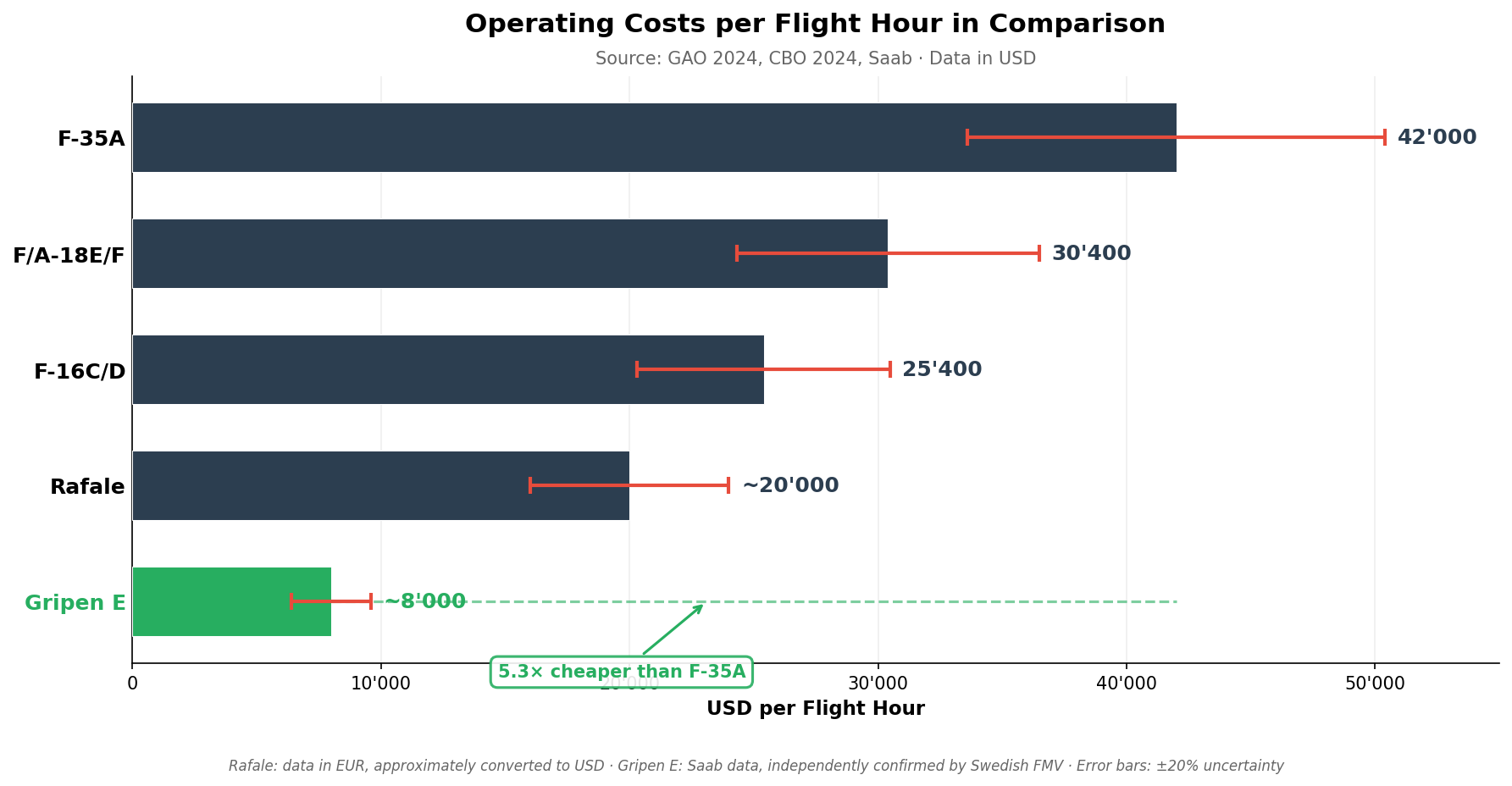
Figure: Operating costs per flight hour in comparison. Source: GAO 2024, CBO 2024, Saab.
¶ 2. Vision of a Mixed Combat Aircraft Fleet
¶ The High-Low-Mix as a Strategic Opportunity
The idea is simple and proven: instead of investing all resources in a single, highly complex aircraft type, the fleet is divided between two complementary models. A smaller portion of highly specialized aircraft handles the most demanding missions, while a larger portion of cost-efficient machines ensures daily operations.
Specifically: 15 F-35A for high-end missions and 35 Gripen E for daily operations -- together 50 combat aircraft within the existing budget of CHF 6 billion.
¶ Benefits at a Glance
| Benefit | Explanation |
|---|---|
| 50 instead of maximum 35 aircraft | Significantly more aircraft available within the same budget |
| Double availability | ~40 mission-capable jets instead of ~18 with a pure F-35 fleet |
| Sovereign daily operations | Air policing on a European platform (Gripen E) |
| Risk diversification | No single-source risk -- if one type has problems, the other remains operational |
| Closer to expert requirements | 50 aircraft are significantly closer to the required 55-70 than 35 or fewer |
| Proven concept | Switzerland successfully operated three types in parallel until 2003 (Mirage III, Tiger, F/A-18) |
¶ Availability: The Decisive Argument
With 35 F-35A and a documented Mission Capable Rate of approximately 51%, only about 18 combat aircraft would be operational in a crisis. A mixed fleet of 50 combat aircraft with a Gripen E availability of over 80% doubles this number.
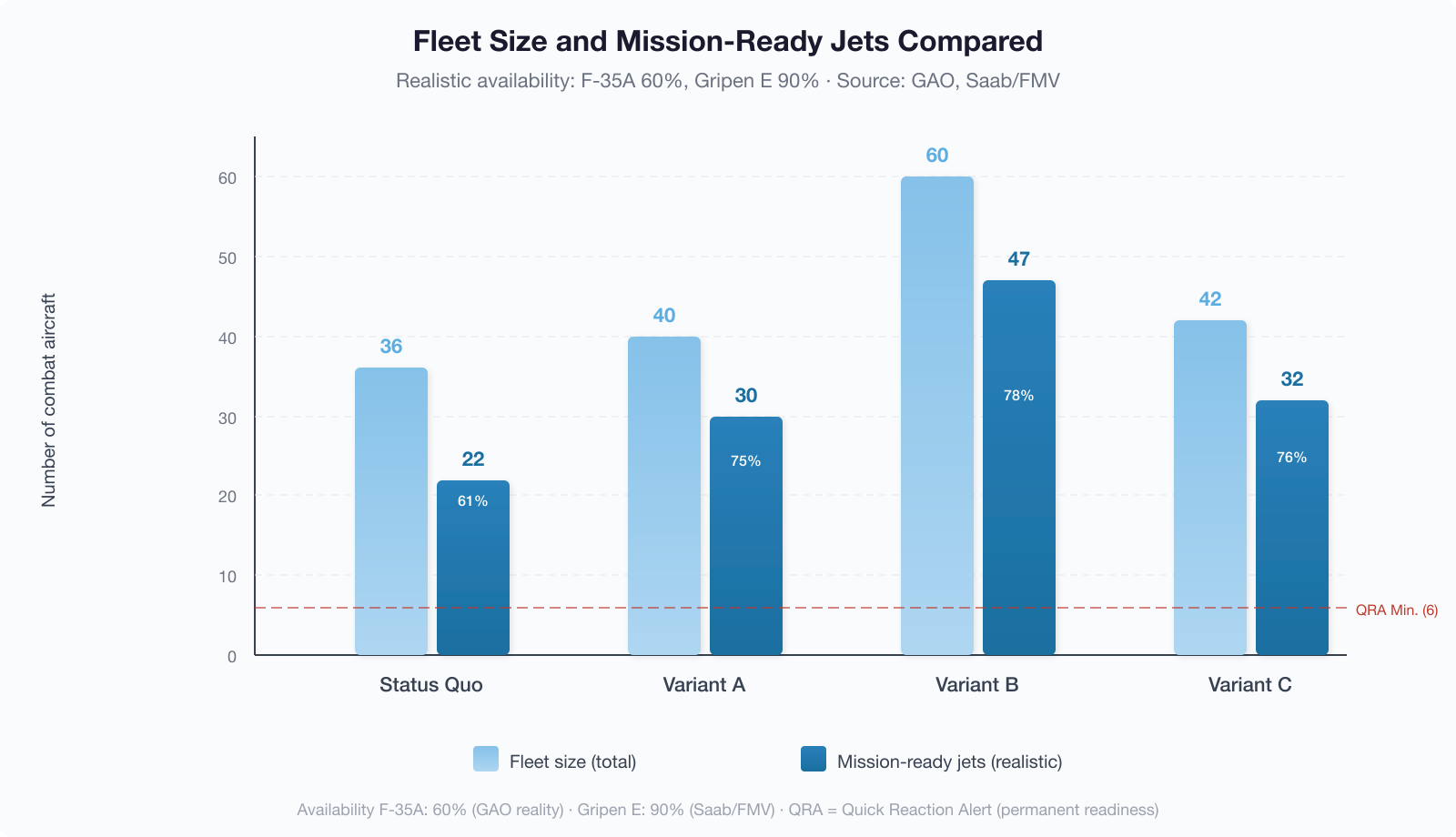
Figure: Fleet size and mission-capable jets in comparison. Source: GAO, Saab/FMV.
¶ Task Distribution: Each Type Where It Excels
| Mission | F-35A (15 units) | Gripen E (35 units) |
|---|---|---|
| First-strike deterrence | Primary | -- |
| Deep strike / SEAD | Primary | -- |
| Air policing (QRA) | -- | Primary |
| Airspace surveillance | Support | Primary |
| Training | Limited | Primary |
| Exercises with partners | Both | Both |
¶ Cost Comparison
The CHF 6 billion budget is sufficient at current prices for a maximum of 35 F-35A -- or for a mixed fleet of 15 F-35A (approx. CHF 2.85 bn) and 35 Gripen E (approx. CHF 3.15 bn), totaling 50 combat aircraft.
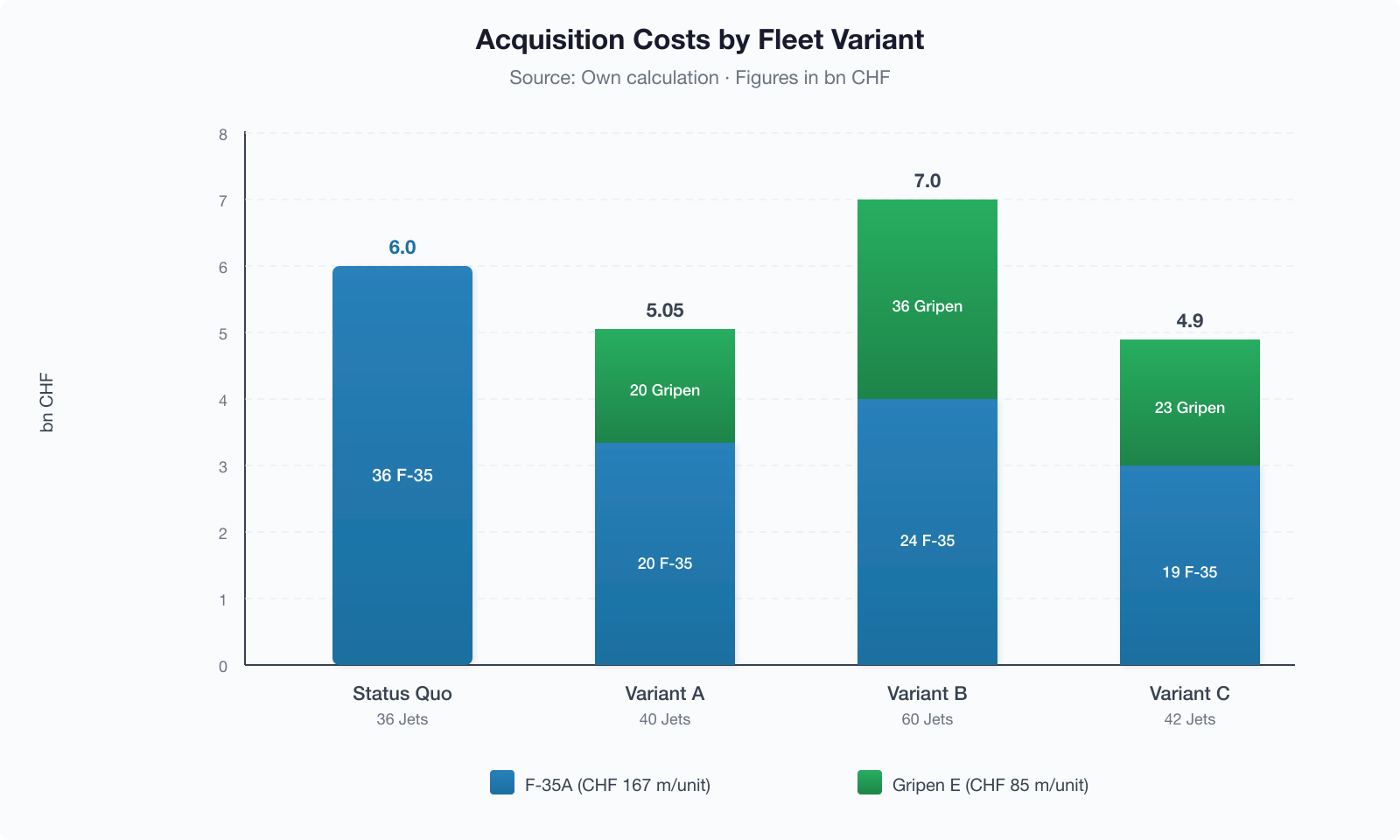
Figure: Procurement costs by fleet variant. Source: Educated Guess.
¶ Scenarios: From 35 to a Mixed Fleet
What happens if Switzerland reduces the number of F-35A and invests the freed-up funds in Gripen E? The following overview shows four scenarios within the existing budget of CHF 6 billion.
| Scenario | F-35A | Gripen E | Total Aircraft | F-35A Cost | Gripen E Cost |
|---|---|---|---|---|---|
| Status Quo | 35 | 0 | 35 | CHF 6.0 bn | -- |
| Scenario A | 25 | 14 | 39 | CHF 4.75 bn | CHF 1.26 bn |
| Scenario B | 20 | 24 | 44 | CHF 3.80 bn | CHF 2.16 bn |
| Vision | 15 | 35 | 50 | CHF 2.85 bn | CHF 3.15 bn |
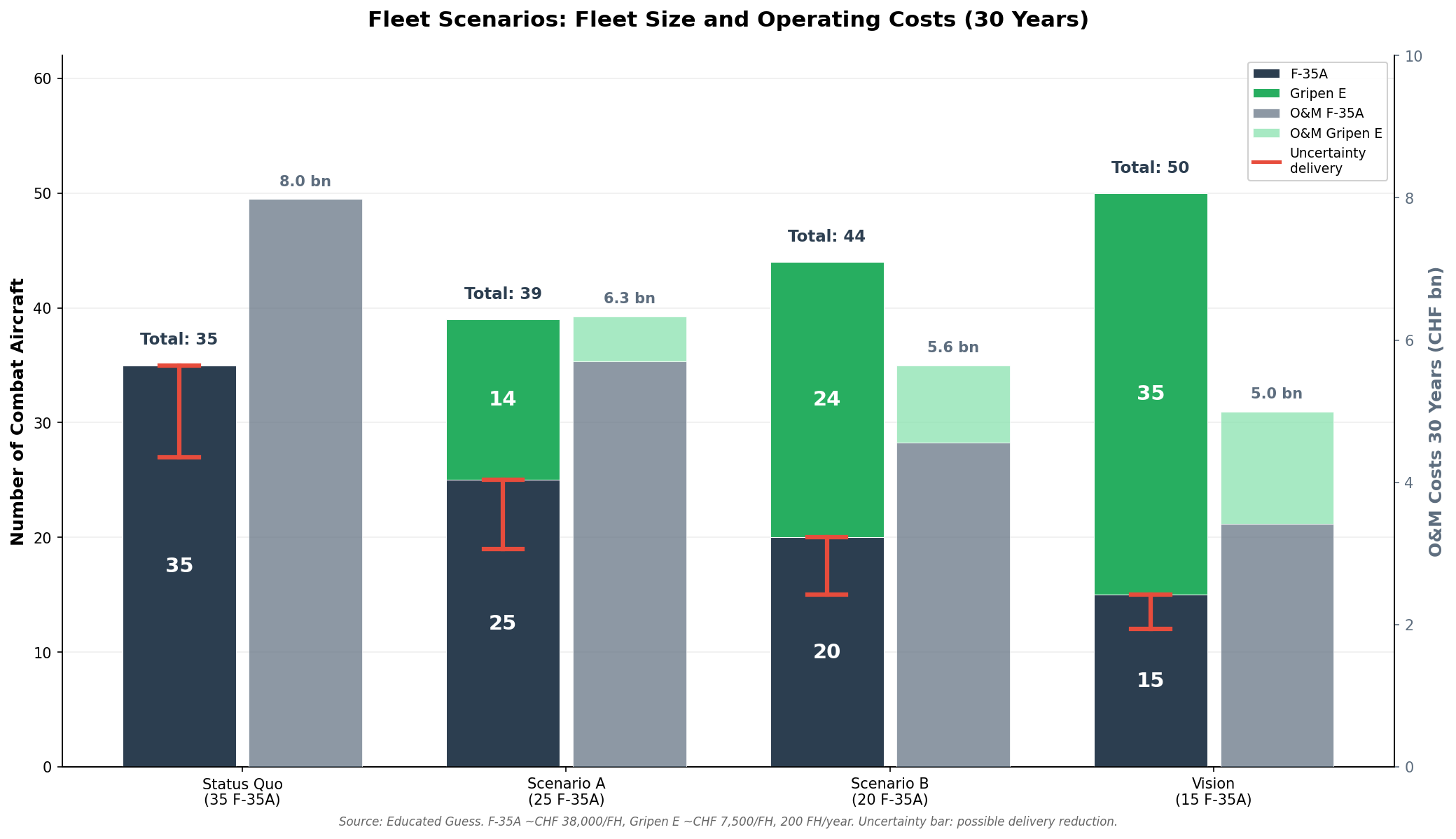
Figure: Fleet scenarios -- fleet size (left) and cumulative operating & maintenance costs over 30 years (right). Red uncertainty bars indicate possible F-35A delivery reductions. Source: Educated Guess (F-35A ~CHF 38,000/FH, Gripen E ~CHF 7,500/FH, 200 FH/year).
Key takeaway: Even a moderate reduction to 25 F-35A enables 14 additional Gripen E -- the total fleet grows from 35 to 39 combat aircraft, while 30-year operating costs drop from CHF 8.0 bn to CHF 6.3 bn. In the vision scenario (15 F-35A + 35 Gripen E), operational capacity doubles within the same budget and operating costs are nearly halved to CHF 5.0 bn.
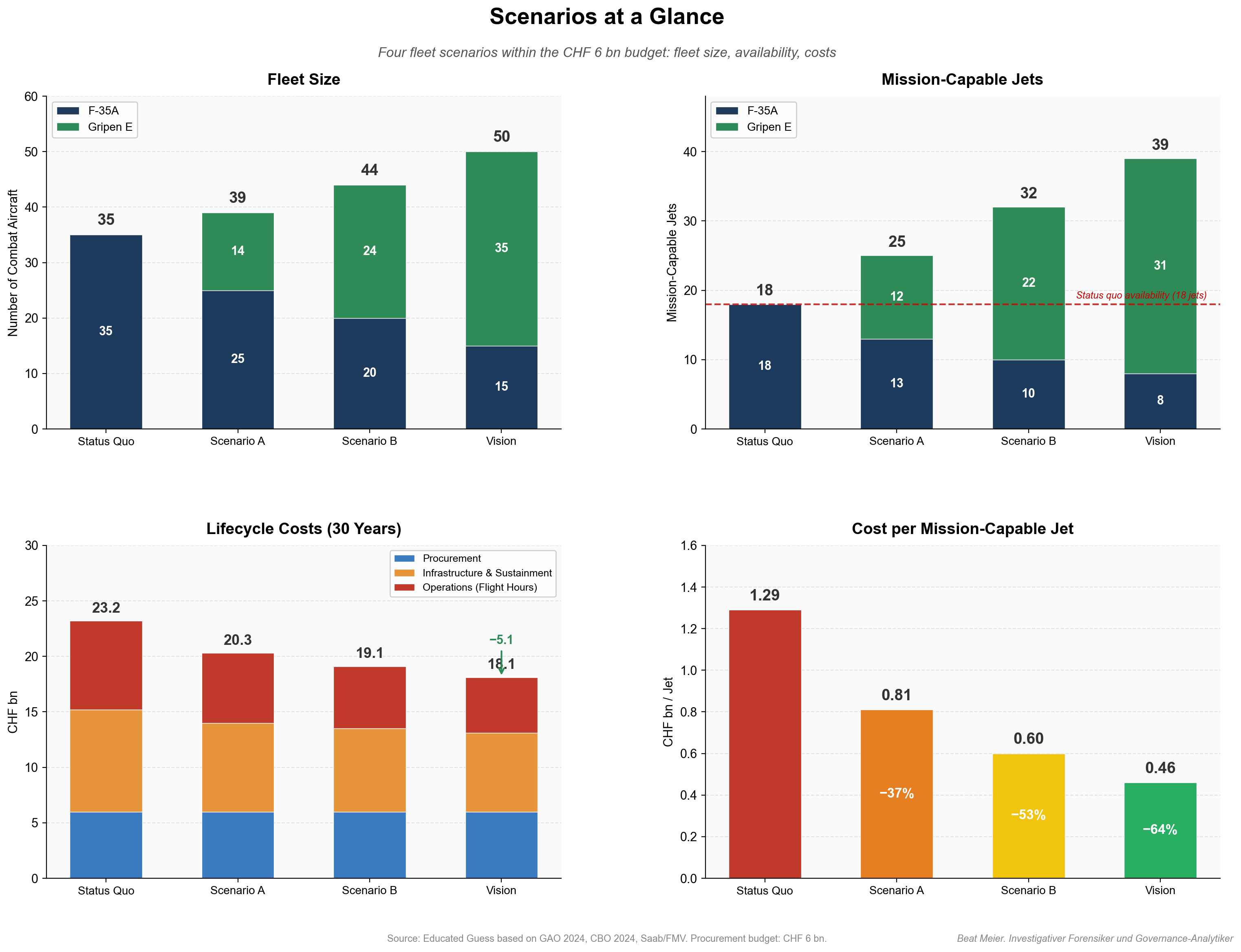
Figure: Scenarios at a Glance -- fleet size, mission-capable jets, lifecycle costs, and cost per mission-capable jet in comparison. Source: Educated Guess based on GAO 2024, CBO 2024, Saab/FMV.
Since the F-35A purchase contract terms are classified, these analyses are based on model calculations using publicly available data. The uncertainty factors are accordingly significant -- yet the analyses reveal clear trends that hold even under conservative assumptions.
¶ Lifecycle Costs: The Long-Term Advantage
The economic advantages of a mixed fleet become particularly evident over the entire 30-year lifecycle. The lower operating costs of the Gripen E accumulate into considerable savings.
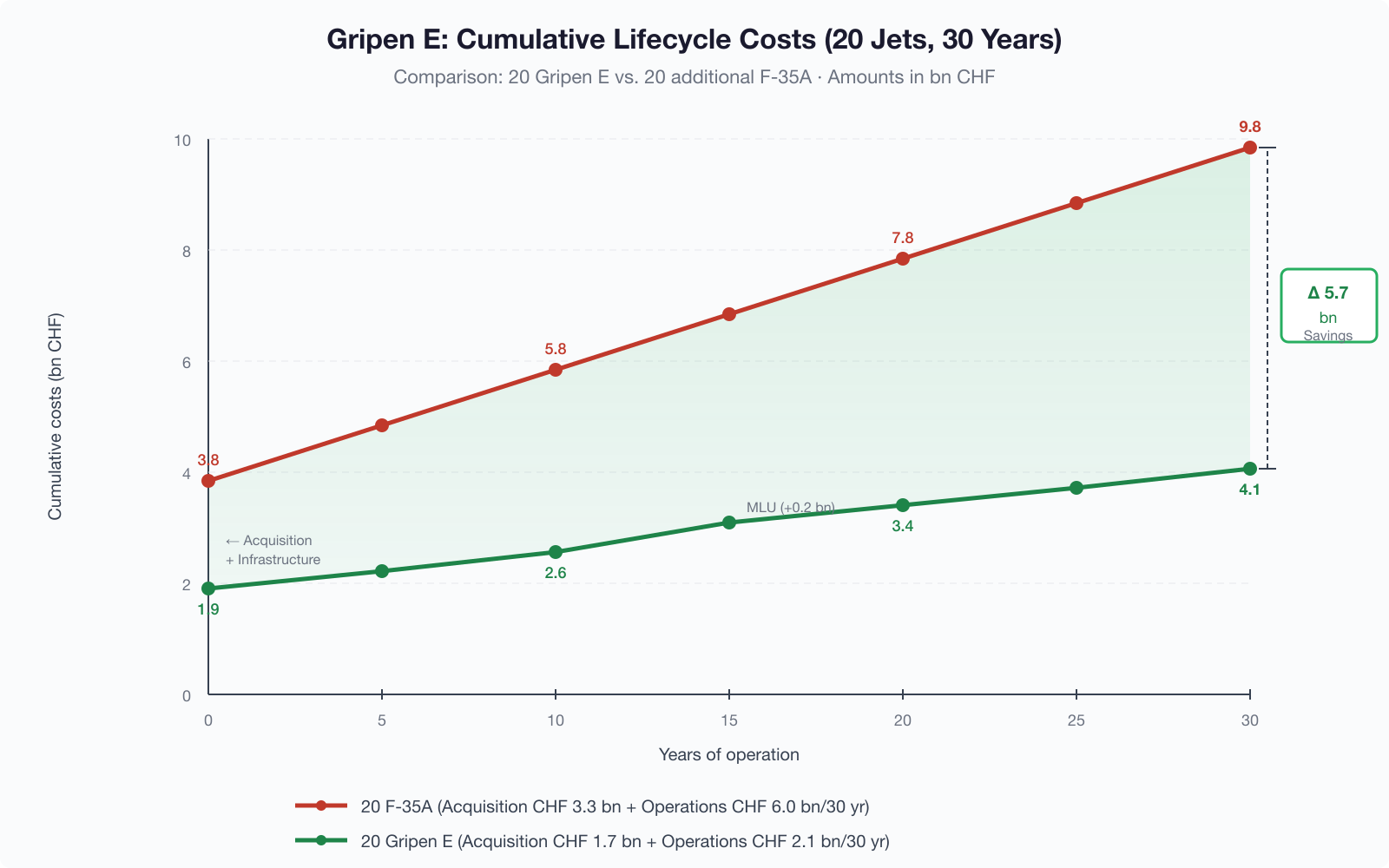
Figure: Cumulative lifecycle costs in comparison (20 jets, 30 years). Source: Educated Guess based on GAO and Saab/FMV.
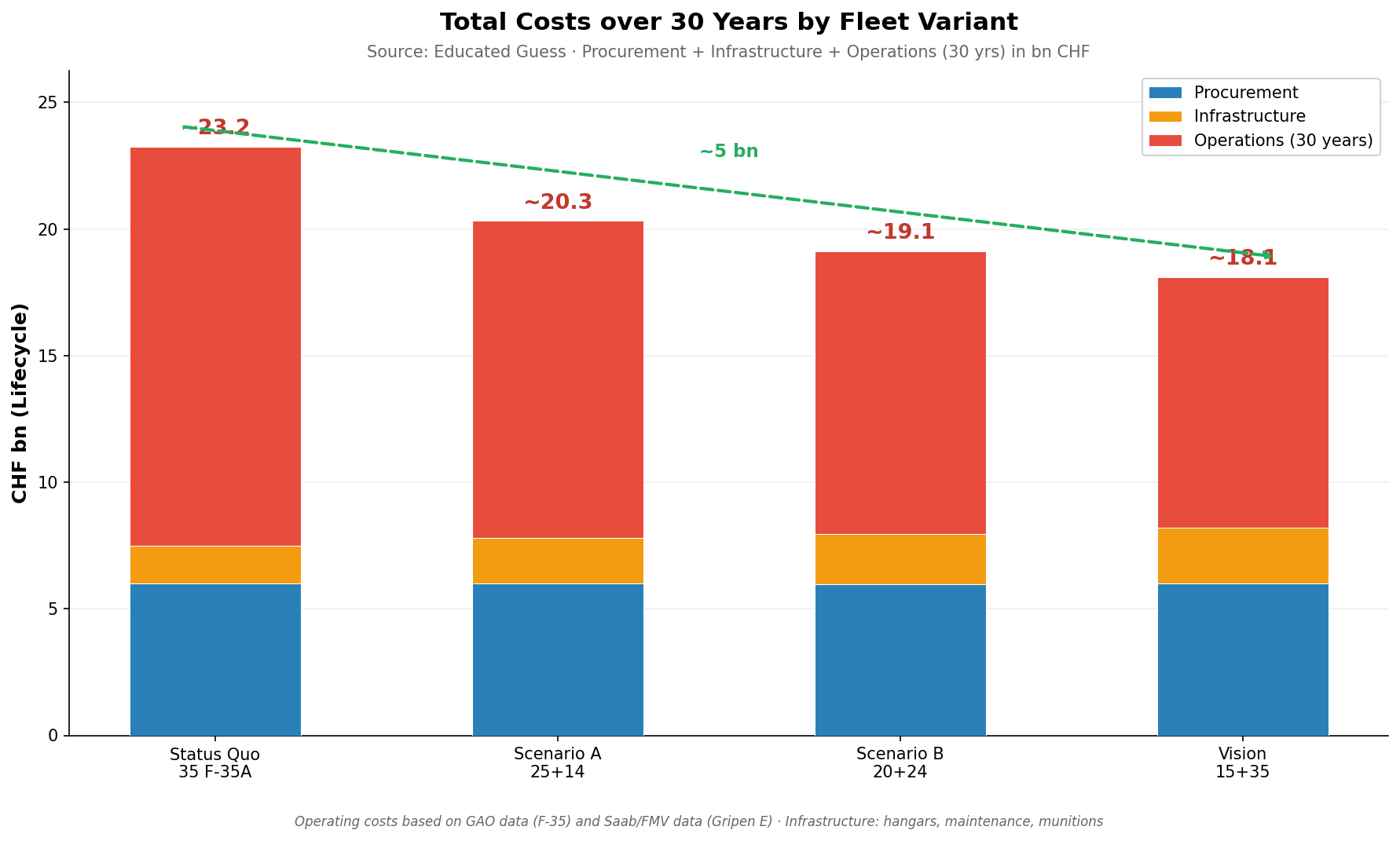
Figure: Total costs over 30 years by fleet variant. Source: Educated Guess.
¶ International Context
Switzerland would not be alone with this approach. Canada is actively discussing a comparable strategy: Saab submitted an offer for 72 Gripen E and 6 GlobalEye surveillance aircraft in 2025/2026. The debate on mixed fleets is gaining momentum internationally.
¶ Implementation Roadmap
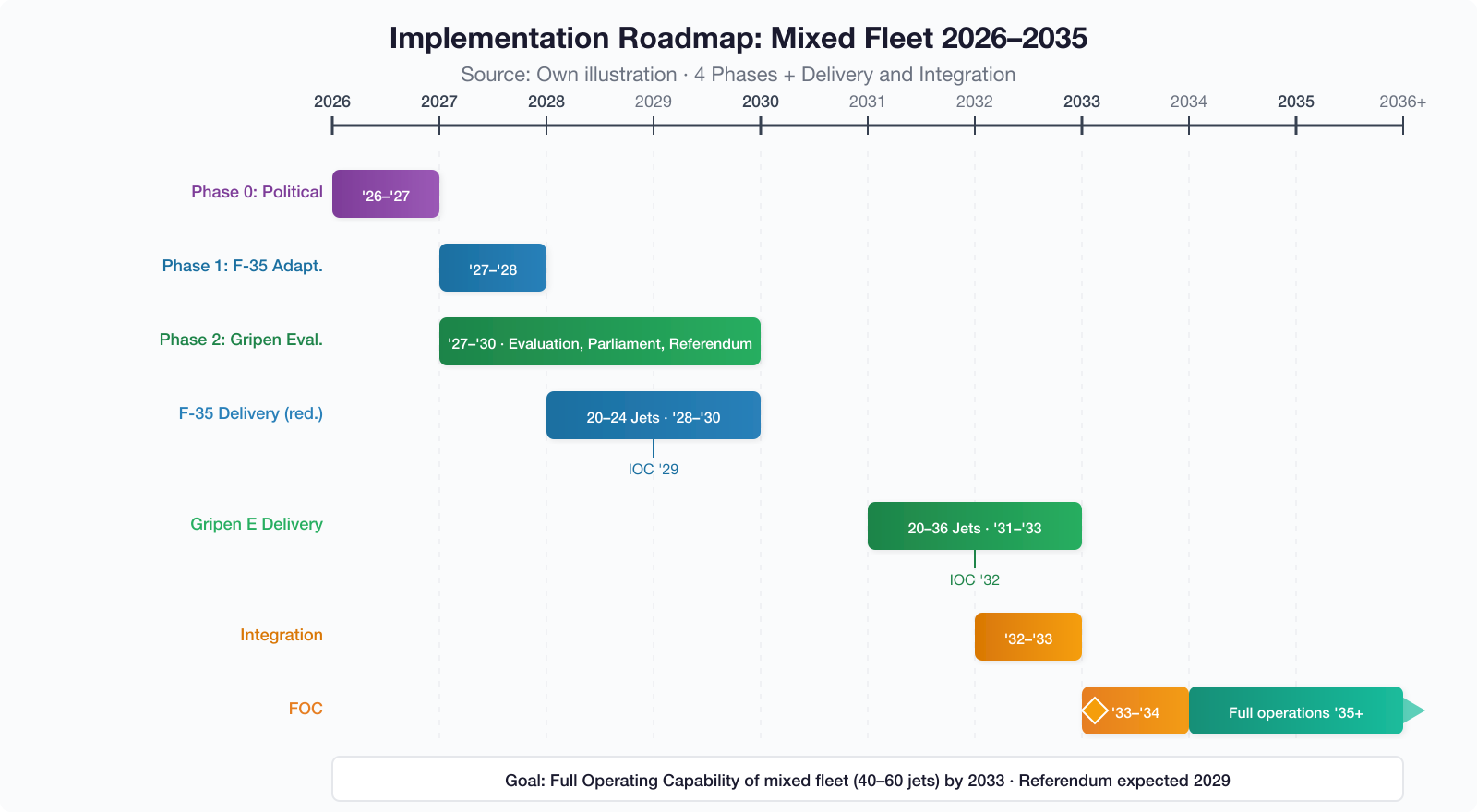
Figure: Implementation roadmap mixed fleet 2026-2035. Source: Own representation.
→ Detailed analysis: Strategic Options for the Combat Aircraft Fleet
¶ 3. MRO -- The Great Opportunity for Swiss Industry
¶ 3.1 What MRO Means and Why It Matters
MRO stands for Maintenance, Repair, Overhaul. MRO is the economic backbone of every combat aircraft program: over the 30-year lifecycle of a fleet, 60-70% of total costs go to MRO. With 50 combat aircraft, this means billions in revenue over decades.
Whoever masters MRO controls operational sovereignty. Whoever depends on foreign MRO providers risks supply bottlenecks, political leverage, and the loss of technological competence.
The three MRO levels:
| Level | Designation | Scope | Location |
|---|---|---|---|
| O-Level | Organizational Level | Daily inspections, refueling, weapons loading, pre-flight checks | Directly on the airfield |
| I-Level | Intermediate Level | Component repair, avionics diagnostics, engine module replacement | In the workshop / maintenance unit |
| D-Level | Depot Level | Overhaul, structural repairs, life extension, software upgrades | At the competence center |
Every MRO level performed domestically strengthens sovereignty and creates highly qualified jobs.
¶ 3.2 The MRO Vision: Switzerland as a European Competence Center
The European F-35 fleet is growing rapidly. 14 nations will operate over 600 F-35s by 2035 -- a massive MRO market.
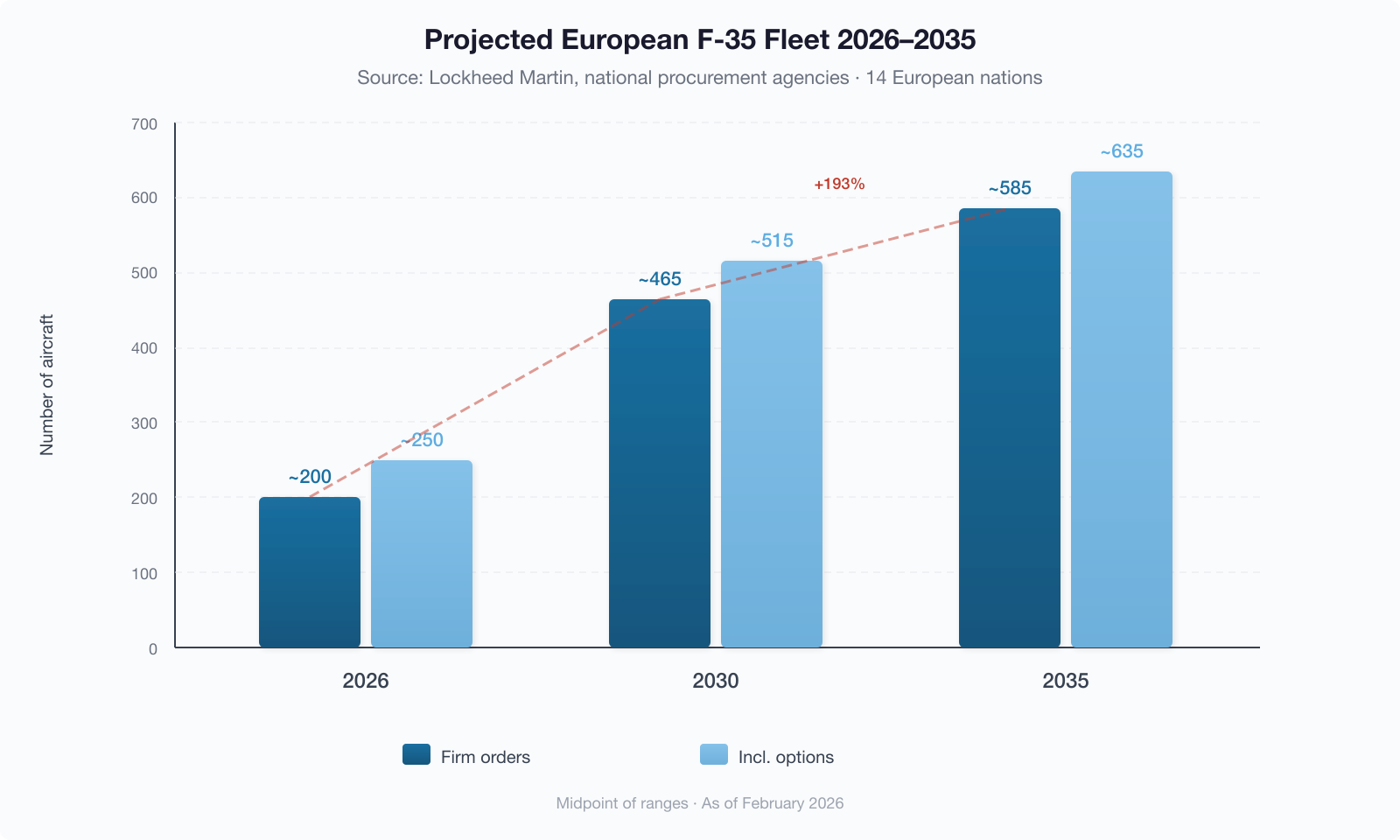
Figure: Projected European F-35 fleet 2026-2035. Source: Lockheed Martin, national procurement authorities.
The vision: Switzerland builds an MRO competence center that not only maintains its own fleet but offers services to European partners. This is not wishful thinking -- successful models exist:
Reference Model Brazil-Sweden (Gripen E):
- Embraer as local MRO partner for the Gripen E
- Over 350 Brazilian specialists trained in Sweden
- Local final assembly and partial manufacturing in Brazil
- Source code access for national software adaptations
Reference Model Finland (F-35A):
- Patria as national MRO hub for the F-35A
- Significant local value creation despite ITAR restrictions
Switzerland could implement the Brazilian model for the Gripen E component of the mixed fleet -- with full technology transfer and source code access. Sweden has already signaled this willingness in previous evaluations.
¶ 3.3 Why Switzerland in Particular?
Switzerland brings ideal prerequisites:
- Globally recognized precision industry (watchmaking, medical technology, mechanical engineering)
- Excellent engineering education (ETH Zurich, EPFL Lausanne, universities of applied sciences)
- RUAG as an existing aerospace MRO provider with experience (F/A-18, PC-21)
- Pilatus Aircraft as a world-class aircraft manufacturer
- Stable political framework and legal certainty
- Geographically central in Europe -- ideal logistics hub for MRO services
- Existing offset obligations as a catalyst and seed funding
- Neutral status: MRO partner without military alliance obligations -- an advantage for customers not wanting NATO dependency
¶ 3.4 Economic Dimension
The MRO vision opens an economic perspective that goes far beyond procurement:
- Jobs: Thousands of high-tech jobs in the aerospace industry -- engineers, avionics technicians, engine mechanics, software developers
- Technology transfer: Know-how development in avionics, engine technology, composite materials, radar and electronic warfare systems
- Long-term value creation: MRO contracts span decades -- stable, predictable revenue for industry
- Export potential: Gripen MRO services for European partners (Sweden, Brazil, Colombia, future users)
- Reduced dependency: Every MRO level performed domestically reduces dependency on foreign supply chains
- Spin-off effects: Technologies from combat aircraft MRO flow into civil aviation, drone technology, and space
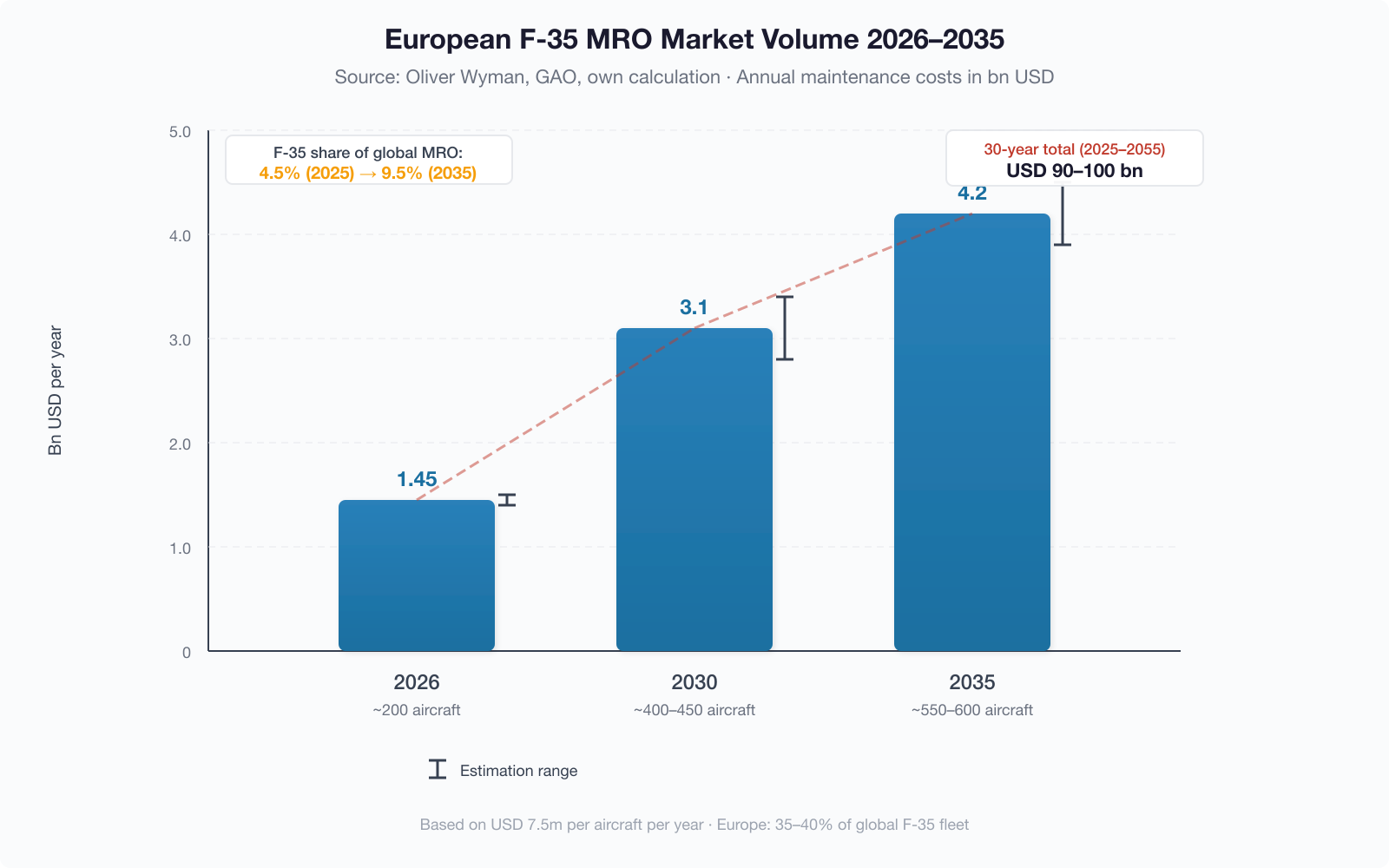
Figure: European F-35 MRO market volume 2026-2035 in billions USD. Source: Oliver Wyman, GAO, own calculation.
¶ MRO Roadmap: From Dependency to Competence (2026-2040)
| Phase | Period | Focus |
|---|---|---|
| Phase 1: Foundations | 2026-2028 | Conclude offset contracts, launch training programs, plan infrastructure |
| Phase 2: O-Level + I-Level | 2029-2032 | Independent maintenance and repair of the Gripen E fleet, first export services |
| Phase 3: D-Level | 2033-2036 | Overhaul and life extension domestically, software competence |
| Phase 4: Export Competence | 2037-2040 | MRO services for European partners, international competence center |
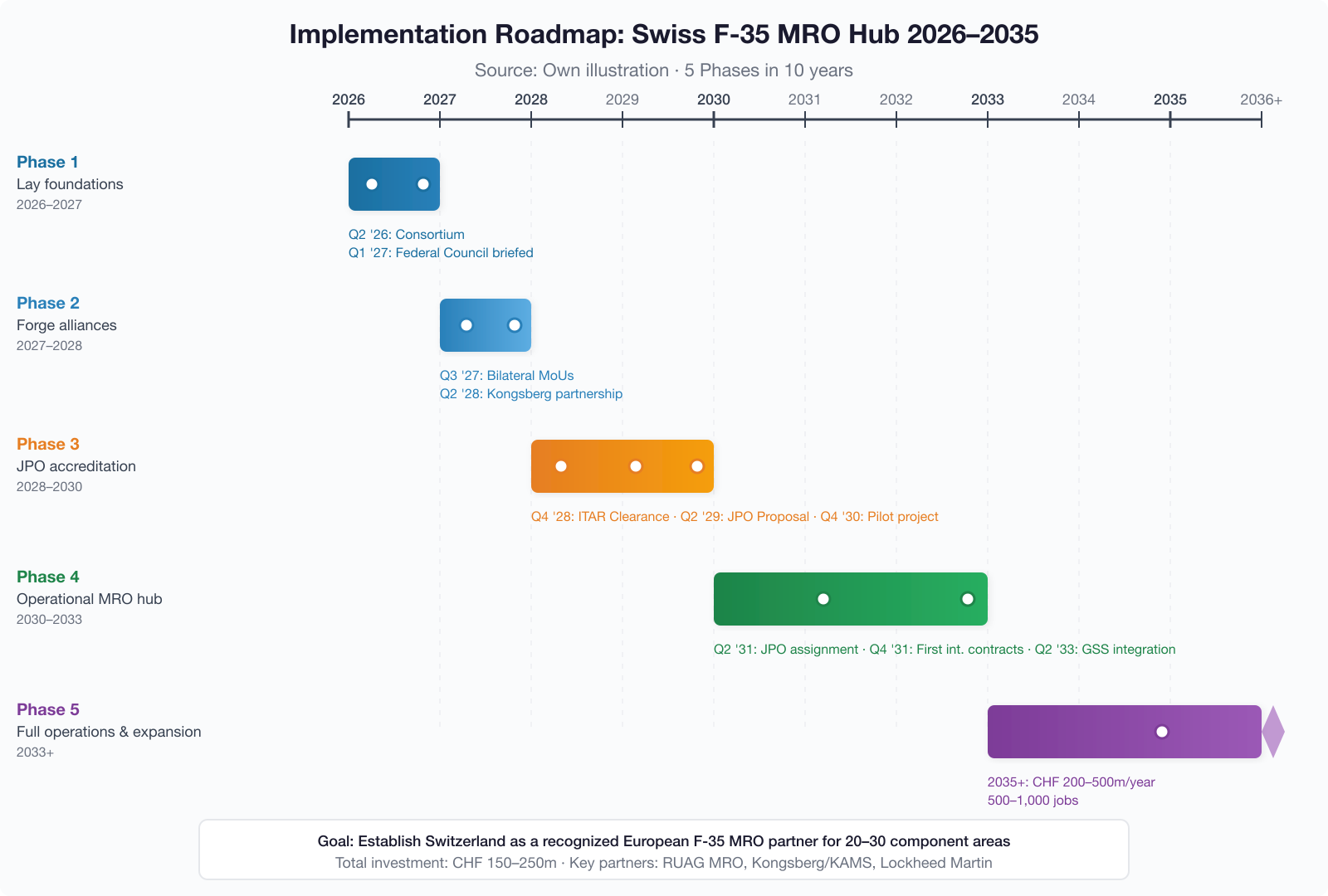
Figure: Implementation roadmap Swiss F-35 MRO hub 2026-2035. Source: Own representation.
¶ 4. Complementary Technologies: The Swiss Ecosystem
The combat aircraft fleet is only one element of air defense. Switzerland has the opportunity to build an interconnected ecosystem that optimally leverages its own strengths:
¶ Passive Sensors (PCL) -- Made in Switzerland
Passive Coherent Location (PCL) uses existing radio signals (DAB+, DVB-T, mobile networks) to locate flying objects -- without emitting its own signals. Switzerland has a dense network of transmitters and the technological foundation for this development. A PCL network complements conventional radar systems and makes airspace surveillance more resilient.
¶ Acoustic Drone Detection -- Swiss Innovation
The threat of drone swarms requires new detection methods. Acoustic sensor networks -- small, affordable, deployable everywhere -- can detect drones at an early stage. Swiss industry (acoustics, sensors, IoT) has the potential to become a leader in this field.
¶ Directed Energy Weapons (DEW) -- Integration Rather Than Isolation
Directed energy weapons (lasers, high-power microwaves) offer a cost-effective response to drone threats. A shot costs cents instead of hundreds of thousands of francs. Switzerland can act as an integrator of these systems into existing air defense.
→ Detailed analysis: Alternative Defense Technologies
¶ 5. Call to Industry: Take the Lead
¶ 5.1 Industry as the Driver of the MRO Vision
Politics has created the framework: offset obligations, a budget of CHF 6 billion, and a security situation that legitimizes defense investments. The studies and analyses are available. The facts speak for themselves.
What is needed now: Industry must take the lead.
It takes companies that seize the initiative and turn the MRO vision into reality -- not waiting for the state to show the way. The MRO competence center will not be decreed from above -- it will emerge from entrepreneurial courage, industrial partnerships, and long-term thinking.
¶ 5.2 Concrete Fields of Action
MRO Core Business (Priority 1):
- Actively initiate partnership negotiations with Saab for Gripen E MRO
- Develop training programs for avionics and engine technology
- Invest in MRO infrastructure (hangars, test benches, specialized tools)
- Secure long-term MRO contracts with the DDPS as an economic foundation
- Form consortia: Swiss companies pooling their competencies
Sensors and Surveillance:
- PCL development in collaboration with ETH/EPFL and armasuisse
- Acoustic drone detection: building a "Swiss Eyes" network
Systems Integration:
- Connected air defense "Made in Switzerland"
- Integration of sensor data, effectors, and command systems
¶ 5.3 The Moment Is Now
The studies are ready. The analyses are complete. The facts speak for themselves.
What is needed now is the courage of Swiss industry to turn this vision into reality. The reins are within reach -- they just need to be seized.
¶ 6. Conclusion: Switzerland Can Do More
Switzerland has everything it takes: first-class engineers, a world-renowned precision industry, excellent educational institutions, and the financial means. The mixed combat aircraft fleet is the bridge between realism and ambition -- it offers more security within the same budget. The MRO competence center is the economic engine that transforms a procurement into a generational project.
It is in our hands.
¶ Studies and Sources
Several comprehensive studies on the topics described in this vision are available and can be requested from the author. The studies include detailed cost analyses, technical comparisons, and strategic assessments.
In-depth analyses in this wiki:
- Strategic Options for the Combat Aircraft Fleet -- Detailed configuration analysis
- Defense Strategy -- Strategic framework
- Alternative Defense Technologies -- PCL, DEW, drone detection
- Threat Landscape for Switzerland -- Security policy context
- Offset Deals and Industrial Participation -- Economic framework conditions