

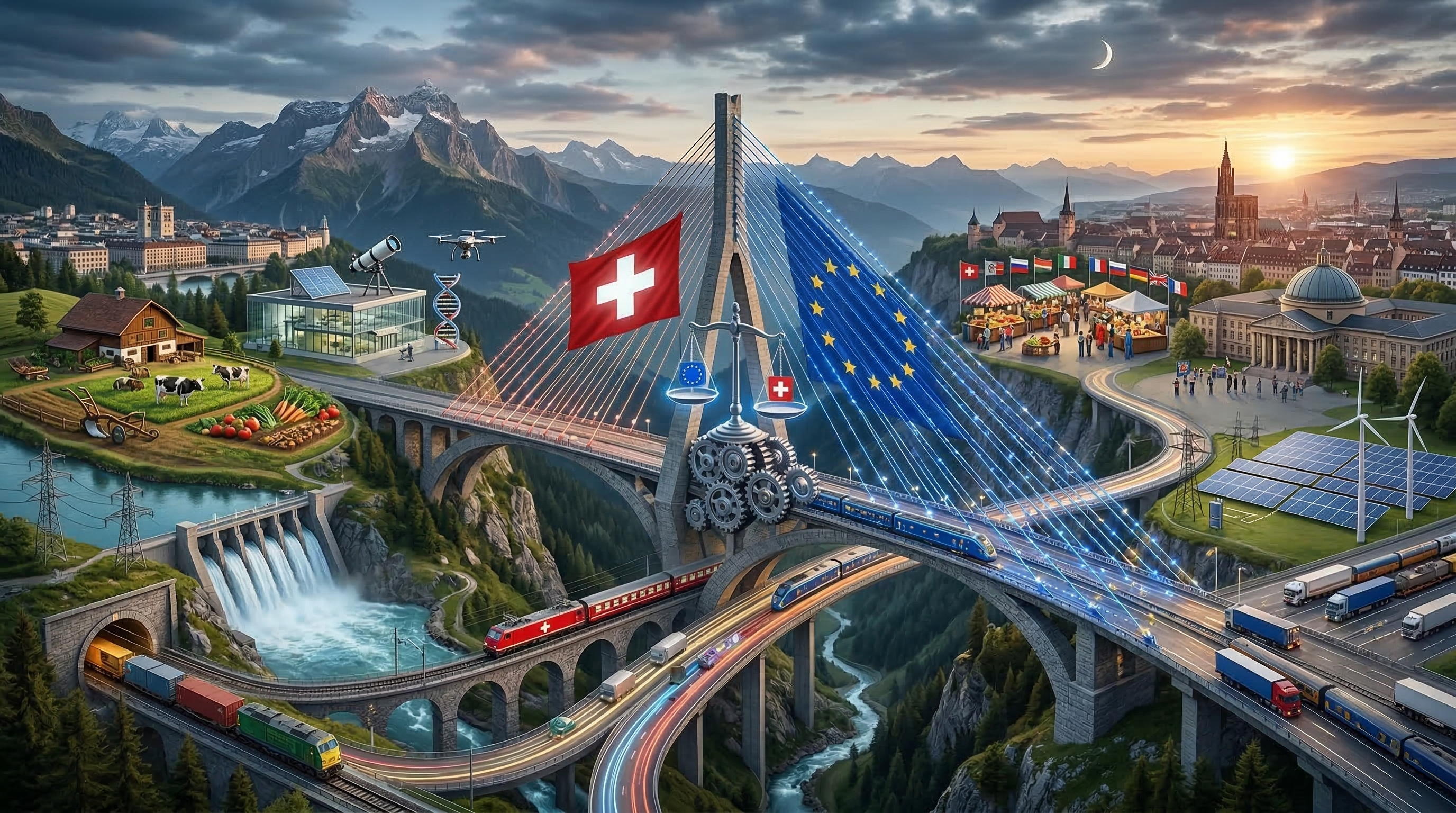
¶ Bilateral Agreements III -- Opportunities and Risks
A fact-based knowledge platform on the agreements of the Switzerland-EU package signed on 2 March 2026 [1].
This wiki provides an insight into the facts and interconnections of the Bilateral Agreements III. The relevant information is scattered across numerous official documents, parliamentary motions, scientific analyses and media reports. The aim of this platform is to bring together in one place the links to all these dispersed sources -- so that every citizen can independently and objectively form their own opinion before the vote.
¶ Politics
Autumn session 2026 (14 September–2 October). Council decisions, pending business and the popular vote are distinguished below.
Politics · National Council · Council of States
¶ National Council
The National Council had not yet debated the treaty package during this session; it is the next chamber to consider it. Parliament report.
¶ Council of States
After voting 29–15 to enter into debate on 28 September, it approved the stabilisation package on 1 October. It wants a majority of both voters and cantons; the National Council must still decide. referendum decision.
¶ Political decisions: as of 6 September 2026
New political decisions checked on 6 September 2026; earlier background retains its stated reference date.
22.05.2026 — In its co-report, the Council of States foreign affairs committee rejected a mandatory referendum on the Switzerland–EU package by 8 votes to 5. This committee position does not settle the final parliamentary decision. Original source.
14.06.2026 — The sustainability initiative 'No to a Switzerland of 10 million!' was rejected in the popular vote. The 14 June ballot is complete; it was not a vote on approving the Bilateral Agreements III package. Original source.
14.08.2026 — The Council of States Foreign Affairs Committee supported the three cohesion credits and the Federal Council’s wage-protection measures. It seeks stronger parliamentary information and consultation rights in dynamic legal alignment and dispute settlement. These are committee positions in ongoing proceedings. Original source.
04.09.2026 — The committee approved the stabilisation component by 9–3 with one abstention. It is ready for the Council of States’ autumn session; the electricity agreement is provisionally expected in winter. The committee supports the proposed immigration levy. This is not final parliamentary approval. Original source.
¶ Where We Stand -- The Current Treaties
- Overview -- Introduction to the existing treaty architecture
- Bilateral Agreements I (1999) -- Seven sectoral agreements with guillotine clause [2]
- Bilateral Agreements II (2004) -- Schengen/Dublin, combating fraud and further agreements [2]
- The Institutional Gap -- Missing mechanisms for dispute settlement and legal adaptation [1][3]
- Erosion of the Treaties -- Estimated erosion costs of CHF 1.3 bn/year [4]
- Comparison Table -- Bilateral Agreements I/II vs. III in direct comparison
- Chronology -- From the EEA vote in 1992 to the signing in 2026
¶ What Is on the Table -- The Bilateral Agreements III
- Overview -- The Switzerland-EU package signed on 2 March 2026 [1]
- The Package Approach -- All agreements negotiated as an indivisible package [1][3]
- Updated Agreements -- MRA, land/air transport, agriculture and free movement of persons [1]
- New Agreements -- Electricity, food safety, health and EU programmes [1][3]
- Dynamic Law Adoption -- Adoption of less than 1% of EU single market law [4]
- Dispute Settlement -- Parity arbitral tribunal with CJEU preliminary ruling on EU law [5]
- Cohesion Contribution -- Regular contribution of around CHF 350 million/year [4]
- Wage Protection Compromise -- 14 domestic measures by the social partners [6]
- Ratification Process -- Parliamentary deliberation and optional referendum [1]
- Bundesrat Press Conference (13.03.2026) -- Key statements on the Bilateral Agreements III dispatch
¶ The Bundesrat Dispatch -- The Official Document
The 1,086-page dispatch 26.023 of the Bundesrat is the central reference document for the Switzerland-EU package. Presented here by topic:
- Overview -- Summary, structure and key figures
- Context -- From the EEA vote in 1992 through Bilateral I and II to Bilateral III
- Options Examined -- The five policy options and the package approach
- Course of Negotiations -- Chronology from exploratory talks 2022 to signing 2026
- Consultation -- Results and the 10 key adjustments
- Political and Economic Assessment -- The Bundesrat assessment
Original text: Dispatch on the Switzerland-EU Package (Bilateral III) -- Full text (PDF, 6.9 MB)
¶ What Switzerland Risks -- Disadvantages and Criticism
- Overview -- The six main points of criticism at a glance
- Loss of Sovereignty -- Switzerland as a "law recipient" without voting rights in EU legislation [7]
- "Foreign Judges" -- The CJEU as a partisan EU body in dispute settlement [7][5]
- Costs and Payments -- Estimated total costs of around CHF 1.4 bn/year [4]
- State Aid Rules -- Sectoral EU rules in air/land transport and electricity [1][3]
- Labour Market -- Feared wage pressure despite wage protection compromise [8][6]
- Opt-out Dilemma -- Formal right of refusal with compensatory measures as leverage [7][5]
- Critics and Opponents -- SVP, autonomiesuisse and trade union reservations [7][8]
¶ What Switzerland Gains -- Advantages and Opportunities
- Overview -- The eight key advantages at a glance
- Legal Certainty -- End of erosion and stable legal framework for business [1][4]
- Single Market Access -- MRA secures >CHF 96 bn industrial exports, medtech blockade lifted [4]
- Research and Education -- Full association with Horizon Europe, Erasmus+ and Digital Europe [1]
- Electricity Agreement -- Winter supply security, around CHF 2 bn/year savings (ETH study) [4]
- Health and Food Safety -- EU early warning systems, pandemic preparedness, simplified border controls [1]
- Digital Economy -- Access to Digital Europe and European innovation networks [1]
- Geopolitical Significance -- Institutional anchoring in times of global fragmentation [1]
- Supporters -- FDP, Centre Party, SP, Greens, GLP, 22 cantons, business and trade unions [1]
¶ About This Wiki
This wiki presents the Bilateral Agreements III in a fact-based and balanced manner. Every point of criticism is documented alongside the counterarguments of supporters; every advantage is accompanied by the reservations of critics. All statements are substantiated with publicly accessible sources.
- About This Wiki -- Purpose, organisation and structure
- Sources and Methodology -- Source hierarchy, citation rules and editorial standards
- Legal Notice -- Imprint, copyright, data protection
Organisation: Pro.Politiq Association (in formation) | Languages: DE, FR, IT, EN, RM
¶ Sources
[1] EDA (2026). Paket Schweiz-EU (Bilaterale III). Federal Department of Foreign Affairs. [Open Access]
[2] EDA (2026). Bilaterale Abkommen Schweiz-EU. Federal Department of Foreign Affairs. [Open Access]
[3] EDA (2026). Faktenblatt: Institutionelle Elemente. Federal Department of Foreign Affairs. [Open Access]
[4] economiesuisse (2026). Bilaterale III -- Die beste Option. Dossier Politik. [Open Access] Note: Business umbrella organisation.
[5] Prof. Astrid Epiney (2025). Streitbeilegung im Rahmen der Bilateralen III. UNSER RECHT / Jusletter. [Open Access]
[6] Travail.Suisse (2026). Einigkeit zwischen den Sozialpartnern über 14 Massnahmen. Travail.Suisse. [Open Access] Note: Employee organisation.
[7] UNSER RECHT (2026). Bilaterale III -- um was geht es? Information platform. [Open Access]
[8] SGB (2026). Nein zur SVP-Chaos-Initiative. Swiss Federation of Trade Unions. [Open Access] Note: Trade union.
Political update: 6 September 2026; background reference: March 2026